

Dell PowerEdge R770 Cuts 3-Year Cloud Infrastructure Costs
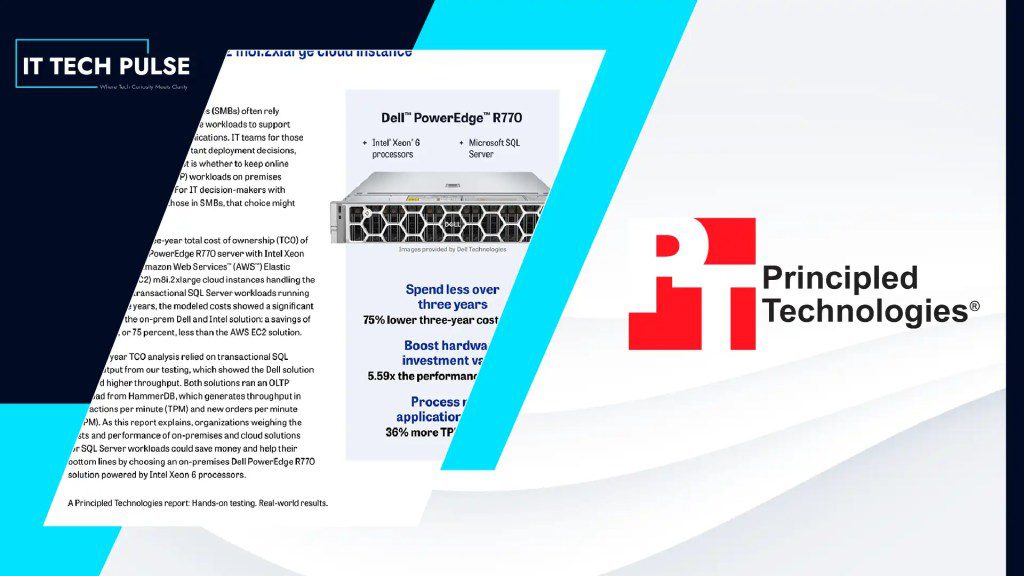
Based on stronger SQL Server performance, Principled Technologies (PT) showed how the server could save nearly $400K vs. a similarly configured cloud solution.
For small and midsize organizations running steady SQL Server workloads, deployment decisions often come down to two practical questions: how much performance a solution can deliver and what it will cost over time. A new PT report compares the three-year total cost of ownership (TCO) and Microsoft SQL Server online transaction processing (OLTP) performance of an on-premises Dell PowerEdge R770 server powered by Intel Xeon 6 processors and Amazon Web Services (AWS) Elastic Cloud Computing (EC2) m8i.2xlarge cloud instances.
The PT study used HammerDB TPROC-C to evaluate transactional SQL Server performance, measuring transactions per minute (TPM) and new orders per minute (NOPM). PT then used those results to model the cost of supporting the same number of 24/7 SQL Server workloads over three years.
Also Read: Infrastructure as Code Governance: Managing Risk in Enterprise Cloud Environments
According to the report, the on-premises Dell PowerEdge R770 solution could reduce modeled three-year costs by $390,031.03, or 75 percent, compared to an AWS EC2 m8i.2xlarge deployment sized to support the same number of workloads. The report also found that the Dell PowerEdge R770 delivered 36 percent higher database performance per VM than the AWS EC2 m8i.2xlarge instance and 5.59 times the NOPM per dollar of the AWS EC2 solution.
The report states, “Cloud and on-premises deployment choices can look different once teams compare actual workload performance against multi-year costs.”
Key results
• 75 percent lower modeled three-year TCO: The Dell PowerEdge R770 solution cost $125,674.09 over three years, compared to $515,705.12 for 28 AWS EC2 m8i.2xlarge instances.
• 5.59x NOPM per dollar: PT calculated higher performance per dollar for the Dell PowerEdge R770 solution using HammerDB TPROC-C throughput and three-year TCO.
• 36 percent higher per-VM database performance: The average VM on the Dell PowerEdge R770 delivered 139,616 TPM and 60,101 NOPM, compared to 102,576 TPM and 44,078 NOPM from the AWS EC2 m8i.2xlarge instance.
• 28 SQL Server VMs on one server: The Dell PowerEdge R770 supported 28 SQL Server VMs in the PT test environment.
Also Read: Infrastructure as Code vs Configuration Management: What’s the Difference?
Why it matters
Many small and medium-sized businesses rely on SQL Server databases for everyday operations, including orders, inventory updates, payments, account checks, and business applications. For these organizations, database infrastructure decisions can affect both application responsiveness and long-term IT spending.
As the report explains, “Spending less on infrastructure can free IT budgets for other priorities such as security improvements, backup and recovery, or application modernization, while higher OLTP throughput can help SQL Server applications complete more database work.”
The report also notes that keeping workloads on premises can give IT teams “host-level visibility and operational control over the hardware, management tools, monitoring practices, and data placement policies supporting their database environment.”
For organizations refreshing database infrastructure or reevaluating cloud spend, the report concludes that these advantages “could make an on-prem Dell PowerEdge R770 solution a strong option for SQL Server OLTP workloads.”
Write to us [wasim.a@demandmediaagency.com] to learn more about our exclusive editorial packages and programmes.