

Prevalent AI Names Nitin Maini CTO to Accelerate AI-Powered Data Fabric
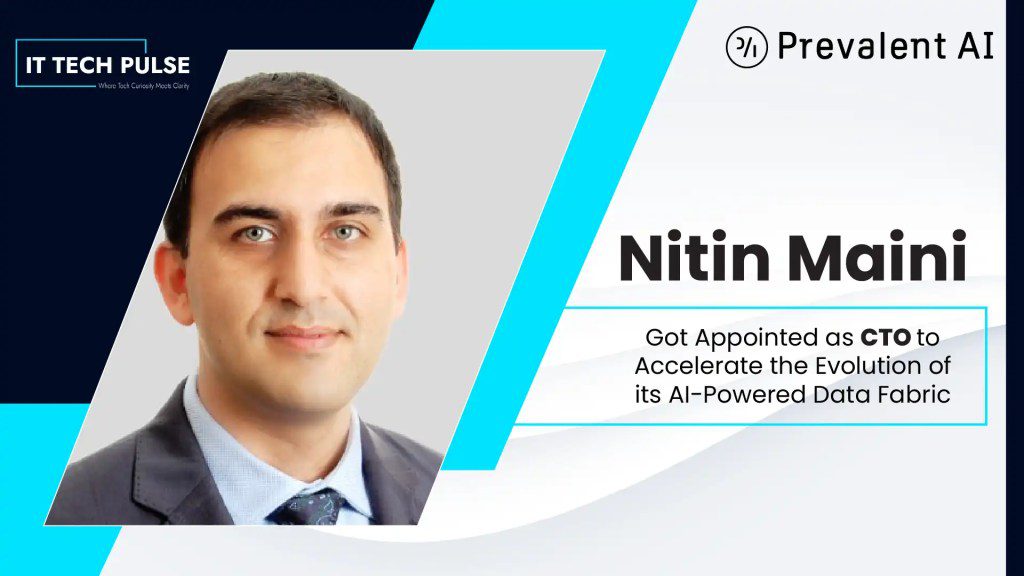
New CTO will lead technology strategy as Prevalent AI aims to meet demand of use cases focused on context and scalability
Prevalent AI, an accelerating leader in AI-powered enterprise context, has appointed Nitin Maini as Chief Technology Officer (CTO) as the company broadens the application of its AI-powered Data Fabric and Knowledge Graph across different enterprise data and AI use cases.
Also Read: IT Tech Pulse Exclusive Interview with Ken Claffey Chief Executive Officer and President of VDURA
Maini, who has more than 20 years of experience across cybersecurity and enterprise software, will shape Prevalent AI’s technology roadmap as the company builds on its established cybersecurity business and extends its approach to unifying and delivering critical context from fragmented customer data into broader enterprise use cases.
He brings significant experience in scaling engineering organisations and building enterprise technology platforms. Most recently, as Senior Vice President of Engineering at Qualys, Maini led a 1,000-plus-person engineering organisation in India and helped drive an AI-first engineering transformation. Before Qualys, he spent almost six years as Chief Technology Officer at Sapience Analytics, following earlier senior engineering roles at Vuclip and BMC Software.
The appointment follows Prevalent AI’s $22 million growth investment from Integrity Growth Partners last month. The investment was the first primary capital raised in the company’s nine-year history and is being used to support global expansion and further development of its offerings for customers across financial services, telecommunications, and critical national infrastructure.
“Prevalent AI has spent nearly a decade building a connected data foundation for complex cybersecurity environments, and Nitin joins us at a point when that foundation has a much broader role to play,” said Paul Stokes, CEO and co-founder of Prevalent AI. “His experience scaling global engineering organisations and leading AI transformation will be important as we extend the Knowledge Graph into new enterprise use cases, such as financial crime analysis and operational intelligence, while continuing to serve our security customers.”
“Across my career, I have seen what happens when complex platforms are built on fragmented data. AI is making that weakness much harder to ignore,” said Maini. “What drew me to Prevalent was the maturity and extensibility of the Knowledge Graph. It gives enterprises a connected foundation that can support security today and broader AI use cases tomorrow as those systems move into production.”
Prevalent AI’s platform connects and resolves data across enterprise systems to build a continuously updated view of assets, identities, controls and their relationships. As AI agents gain greater access to internal systems and workflows, Maini believes that trusted enterprise context is critical if enterprises are to use them reliably in production.
“Every enterprise I speak to wants to move AI into production, but confidence drops quickly once agents are expected to act inside live systems. They need current context about the organisation they operate in and how its systems are connected. My ambition is for Prevalent AI to become the trusted data and context layer for enterprise AI, with the Knowledge Graph extending from cybersecurity into areas such as governance, risk and compliance,” said Maini.
Write to us [wasim.a@demandmediaagency.com] to learn more about our exclusive editorial packages and programmes.


