
AGI vs AI: Understanding the Differences Between AI, Generative AI, Agentic AI and What Comes Next
Stay updated with us
Sign up for our newsletter
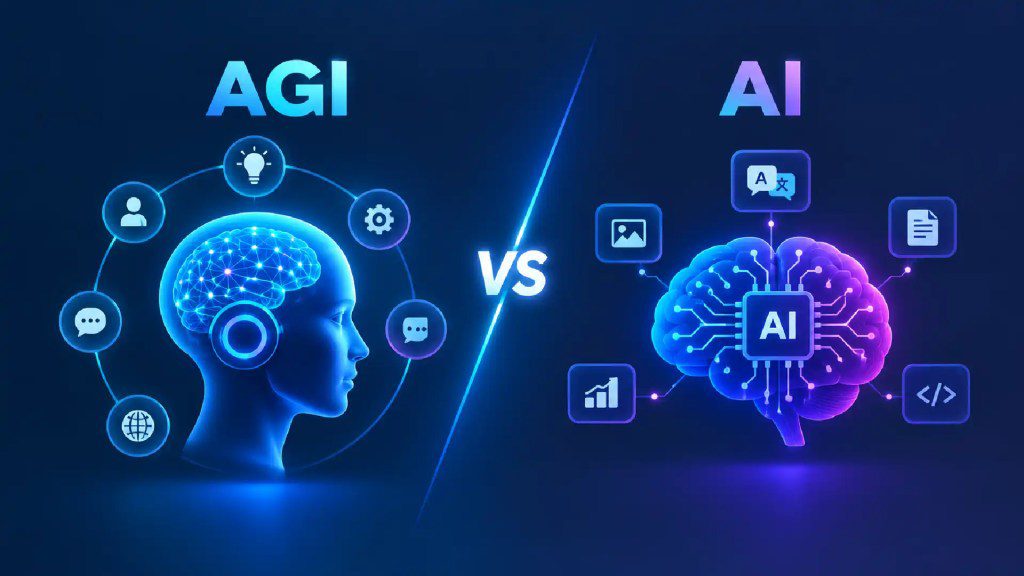
Enterprise AI discussions often blur three separate ideas. Generative AI, agentic AI and AGI are described as consecutive stages of one technology, yet they represent different capabilities. A generative model creates content. An agentic system uses tools to complete a workflow. AGI is a proposed level of adaptable intelligence that has not been demonstrated to any universally accepted standard. The AGI vs AI distinction matters because it shapes where organisations invest, what they deploy and what results they can realistically expect. Misreading these terms can lead to choosing the wrong capability for a business requirement. Vendor marketing rarely helps draw these lines.
What Is Artificial Intelligence?
Artificial intelligence is the umbrella discipline covering systems that perform tasks associated with human intelligence. It spans machine learning, deep learning, natural language processing, computer vision and predictive analytics. Fraud detection, demand forecasting, predictive maintenance, customer segmentation and document classification are established applications.
These common types of AI are predominantly narrow, trained for defined tasks and environments. That gap sits at the centre of artificial general intelligence vs AI: narrow systems specialise in particular problems, while general intelligence would adapt across a much broader range of tasks.
What Is Generative AI?
Where conventional predictive models classify or forecast, generative AI produces new outputs. Large language models generate text and code, diffusion models generate images, and multimodal foundation models work across text, images and audio.
Enterprises use them to summarise documents, draft reports, assist developers and power knowledge assistants, though capabilities vary by model. On generative AI vs AGI, fluent output is not proof of broad intelligence. A model can write convincing prose and still struggle with unfamiliar problems or multi-step reasoning.
What Is Agentic AI?
Agentic AI describes how a system operates. Given an objective, an agent can break it into steps, plan, call tools and APIs, retrieve information, retain context, check results and iterate, within defined permissions and human oversight.
A chatbot answers a prompt. An agent might investigate a support ticket by querying an internal database, checking service status and starting an approved workflow. Many agents use generative models for reasoning, so the two overlap rather than compete.
On agentic AI vs AGI, the distinction is straightforward: an agent can be autonomous within a narrow task without being generally intelligent. Autonomy describes how much a system does unsupervised, not how widely it can reason; a ten-step agent may still be a narrow specialist.
What Is Artificial General Intelligence?
Artificial general intelligence explained simply is a proposed level of AI that learns across domains, transfers knowledge to unfamiliar tasks and solves problems flexibly rather than excelling at one specialised function.
There is no universally accepted definition or test, and researchers and companies frame AGI differently, some emphasising performance on economically valuable tasks, others adaptability and learning new skills.
Google DeepMind researchers addressed this ambiguity in their Levels of AGI framework, which separates performance, generality and autonomy rather than treating AGI as one threshold.
Is AGI achieved today? No broadly accepted, independently verified standard says it has.
Also Read: How Close Are We to AGI in 2026? What the Latest AI Capabilities Tell Us
AGI vs AI vs Generative AI vs Agentic AI: Key Differences
| Dimension | AI | Generative AI | Agentic AI | AGI |
| Meaning | Broad field of intelligent systems | Systems that generate content | Systems that pursue goals through actions | Proposed general-purpose intelligence |
| Core capability | Prediction, classification, perception | Content generation | Planning, tool use and execution | Broad, adaptable intelligence |
| Autonomy | Varies | Usually responds to inputs | Acts within permissions | Not defined by autonomy |
| Status | Widely deployed | Widely deployed | Increasingly deployed in defined workflows | Not established |
Generative AI creates, agentic AI acts, and AGI describes a proposed level of generality. The categories overlap, since agents often run on generative models, so AGI vs generative AI and AGI vs agentic AI compare different dimensions: content, goal-directed execution and generality. Automation, however advanced, is not AGI.
Why These Differences Matter for Enterprises
Labelling every LLM-powered application agentic creates governance problems. A drafting assistant and a system permitted to modify production records need very different controls.
Generative AI drafts the answer; agentic AI acts on it. In software engineering, an agent might examine a codebase, run tests and propose fixes within defined permissions, with a developer reviewing every change before merging.
Consequential actions need human approval. AGI is not a prerequisite for enterprise AI adoption. Ask whether a system’s capabilities match the task, permissions and reliability required, not whether it sounds intelligent.
Industry Perspective
OpenAI, Google DeepMind, Anthropic and Meta develop foundation models with capabilities spanning language, multimodal processing and tool use. Microsoft and IBM integrate AI capabilities into enterprise platforms, while NVIDIA supplies computing infrastructure for model training and inference. Tool-using agents are increasingly deployed in defined workflows; AGI remains a research goal approached through differing definitions. Commercial progress is best judged by demonstrated capability, reliability and real-world performance, not terminology.
Conclusion
AGI vs AI is a question of scope. AI is the broader field, generative AI creates content, agentic AI extends systems into goal-directed workflows, and AGI remains a broader, debated concept of general intelligence. Enterprises should define their business requirements first, then select the capabilities and controls that meet them.
FAQs
What is the difference between AI and AGI?
AI is the broad field of building systems that perform intelligent tasks, often within narrow domains. AGI describes a proposed level of broad, adaptable intelligence across different tasks and domains.
How is Generative AI different from AGI?
Generative AI produces content such as text, images and code. AGI refers to general-purpose intellectual capability across a broad range of tasks.
What is the difference between Agentic AI and AGI?
Agentic AI concerns goal-directed planning and action, while AGI concerns the breadth and adaptability of intelligence. An agent can execute tasks autonomously while remaining limited to particular domains, tools or objectives.
Is Agentic AI a form of AGI?
No. Agentic AI does not automatically qualify as AGI. An agent may handle multi-step tasks independently yet lack the broad reasoning and cross-domain adaptability AGI implies.
Write to us [wasim.a@demandmediaagency.com] to learn more about our exclusive editorial packages and programmes.