

AI Coding Agents vs. AI Copilots: How Software Development Is Moving Towards Autonomous Engineering
Stay updated with us
Sign up for our newsletter
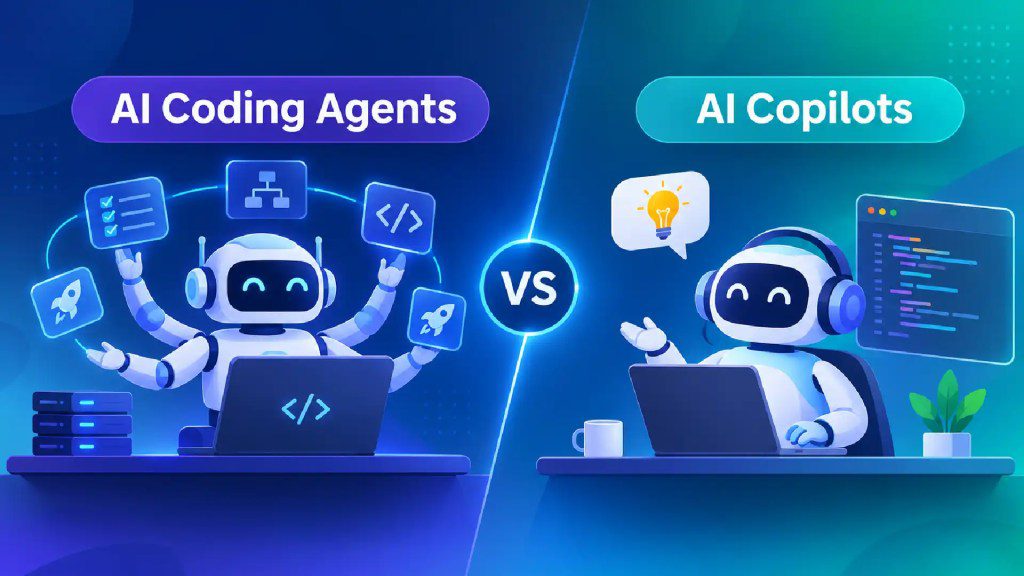
A pull request is waiting at nine in the morning. Overnight, something traced a bug, wrote a fix, ran the test suite, chased a failing check and packaged the result for review. That gap between a tool that helps and a tool that executes separates AI coding assistants from AI coding agents. Copilots primarily assist developers who direct every step. AI coding agents can increasingly execute multi-step development tasks with less continuous human direction.
From AI Coding Assistants to AI Coding Agents
Early AI developer tools lived in the editor and predicted the next line. Chat added explanations and snippets, but the developer still pasted, ran and debugged. The newer step is execution: reading a repository, editing several files, running commands and tests, and reacting to the output. The progression runs from suggest to generate to execute, then test, debug and iterate.
A tool that only suggests leaves the developer to discover whether it works; one that runs the tests sees the failure itself and tries again. That closed loop makes agentic software development a different activity from faster autocomplete.
AI Coding Agents vs. Copilots: What Actually Changes?
A copilot waits for the next prompt, while an agent accepts an objective such as “fix the failing checkout test” and chooses the steps. Scope grows from a function to a change set, tool access from the open buffer to shells and Git, and human involvement from constant direction to checkpoints.
The vendors show the range. Anthropic describes Claude Code as a terminal-based agentic tool that edits files, runs commands and manages Git workflows. OpenAI’s Codex works in isolated cloud sandboxes preloaded with a repository and can propose pull requests, though OpenAI says users should still review and validate generated code. GitHub’s Copilot coding agent takes an assigned issue, opens a draft pull request and requests review. Cognition calls Devin an autonomous software engineer, the boldest framing here and the company’s own description. Autonomy is closer to a dial than a label.
How Agentic Software Development Changes the Developer Workflow
Take a flaky payment-retry test. With a copilot, the developer reads the failure, forms a theory, asks for a patch, applies it and reruns the suite.
With an agent, the developer states the objective and constraints. The agent inspects the repository, plans the change, modifies files, runs tests, investigates failures and iterates. A proposed change comes back for review.
The developer’s work moves toward direction, verification, architecture and judgment, which is not passive supervision. Verification means asking whether the passing test is meaningful and whether the fix addresses the cause.
What AI Coding Agents Mean for Engineering Teams
Code review absorbs the first impact. If agents raise pull request volume, reviewers become the bottleneck, and a team that counts commits will watch the numbers climb while review queues and rework grow quietly. Developer productivity and engineering effectiveness are different measures. Google Cloud’s 2025 DORA research points the same way: AI adoption was linked to higher delivery throughput but lower delivery stability, and the report describes AI as an amplifier of existing practices.
Testing carries more weight. Passing tests show only that the agent satisfied the tests that exist, and an agent optimising for green can satisfy a test without satisfying the requirement. Onboarding and maintenance may benefit, since an agent can explain an unfamiliar service, though code generated quickly becomes technical debt when nobody fully understands it.
Autonomous Coding Agents Need Stronger Guardrails
An agent that performs well on a sample repository can create a different problem once it meets private code, secrets, deployment pipelines or customer data. Risks include exposed credentials, unvetted dependencies, unsafe shell commands, insecure generated code and unreviewed changes.
As autonomy rises, permissions, testing, review and governance matter more, especially for AI coding automation inside CI. Platform teams are the natural owners of this layer: sandboxes, scoped repository access, approval prompts and audit logs recording what an agent read, ran and changed. Autonomy should scale with risk, since a documentation fix and a change to payment logic should not share one policy.
What Software Engineering Leaders Should Do Now
- Start with bounded work such as test coverage, dependency updates and small refactors.
- Decide where agents can read, write and execute, using least-privilege tokens and no default production access.
- Keep CI, tests and security scanning mandatory for agent-authored changes.
- Give platform teams ownership of agent sandboxes, permissions and audit logs.
- Require human approval for authentication, payments, data migrations and public APIs, and track rework and defect escapes beside cycle time.
Conclusion
The important shift is not from developers to AI. It is from developers manually executing every step toward directing, reviewing and governing AI-driven engineering workflows. AI software engineering is still an evolving model, not a settled reality. The winning organisation will not necessarily be the one with the most autonomous agents. It will be the one that knows where autonomy helps, where humans must stay involved, and how to measure the difference.
Write to us editorial@demandmediaagency.com. to learn more about our exclusive editorial packages and programmes.
FAQs
What is the difference between an AI coding agent and an AI copilot?
A copilot assists a developer who drives each step, while an AI coding agent accepts a higher-level objective, inspects the repository, edits files, runs tests and iterates on the results. Many products now combine both modes, so the difference is one of degree.
Are AI coding agents replacing software developers?
No. Agents can take on well-scoped execution work, but developers still set objectives, review changes, make architectural decisions and own business logic and risk. The role shifts toward direction, verification and judgment, and someone must remain accountable for what reaches production.
What are the risks of using autonomous coding agents?
The main risks are insecure or incorrect generated code, vulnerable dependencies, exposed secrets, excessive permissions, unsafe commands and unreviewed changes. Passing tests does not prove correctness. Scoped permissions, mandatory testing, human approval gates and audit logs reduce these risks without removing the need for review.


