
Data Fabric vs Data Mesh: What’s the Difference and Which Model Fits Enterprise AI?
Stay updated with us
Sign up for our newsletter
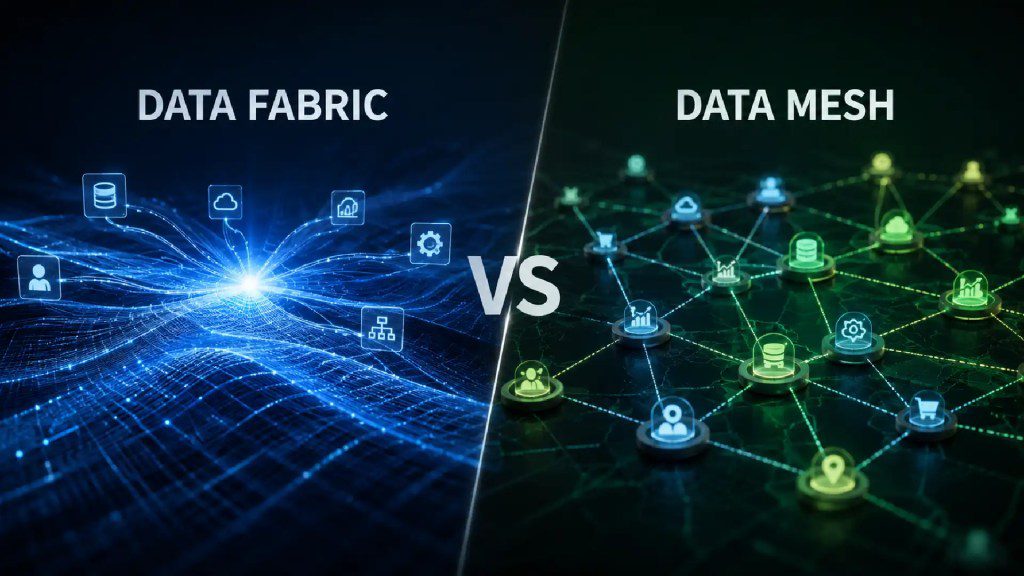
As enterprises scale AI initiatives, data architecture has become a strategic decision rather than a backend technology discussion. AI systems need access to data that is accurate, governed, discoverable, and available across business functions. Two approaches frequently enter the conversation: Data Fabric and Data Mesh.
Although they are sometimes presented as competing architectures, they solve different problems.
Data Fabric focuses on connecting and governing distributed data through an integrated architectural layer. Data Mesh focuses on changing who owns and manages data by treating it as a product owned by business domains.
What Is a Data Fabric?
A Data Fabric is an architectural approach designed to connect data across distributed environments while making it easier to discover, access, govern, and use.
It typically brings together:
- Data integration
- Metadata management
- Data catalogs
- Data lineage
- Data quality
- Governance
- Automation
- Analytics and AI access
The goal is not necessarily to move all enterprise data into one location. Instead, a data fabric creates an interconnected layer that helps organizations work with data across cloud, on-premises, SaaS, databases, and other environments.
This becomes particularly relevant for AI. An AI application may need information from CRM systems, ERP platforms, documents, data warehouses, and operational databases. A data fabric can help connect these sources while maintaining governance and visibility.
Read more: Enterprise AI Agents
What Is Data Mesh?
Data Mesh takes a different approach.
Instead of primarily focusing on technology for connecting data, it changes the organizational model around data ownership.
Under a data mesh model, individual business domains—such as finance, marketing, supply chain, or customer operations—take responsibility for their own data products.
Four principles are commonly associated with data mesh:
- Domain ownership — business domains own their data.
- Data as a product — data is treated as a usable product with defined quality and consumers.
- Self-service infrastructure — teams receive tools that allow them to publish and consume data.
- Federated governance — governance standards are coordinated across domains while allowing domain-level ownership.
This can help address a common enterprise problem: a centralized data team becoming a bottleneck for every data request.
Data Fabric vs Data Mesh
The simplest distinction is:
| Data Fabric | Data Mesh |
| Primarily an architectural approach | Primarily an organizational and architectural approach |
| Focuses on connecting distributed data | Focuses on distributed data ownership |
| Relies heavily on metadata and automation | Relies heavily on domain teams |
| Centralized technology layer can play a major role | Decentralized ownership is fundamental |
| Helps improve data accessibility and governance | Helps improve accountability and domain expertise |
Which Is Better for Enterprise AI?
The answer depends on the organization’s problem.
If the primary challenge is “Our data exists everywhere and our AI applications cannot reliably access it,” a data fabric may be the stronger starting point.
If the problem is “Nobody clearly owns the quality and usability of our data,” data mesh principles may address the deeper issue.
For many large enterprises, the practical answer may be a combination.
A data mesh can establish who owns data, while a data fabric can provide the technology layer that connects, governs, discovers, and delivers that data.
That combination becomes particularly powerful for AI workloads. AI agents and generative AI applications need both trusted information and reliable access to it.
This connects directly with the broader discussion around AI Data Governance and the role of data within Enterprise AI Architecture.
What Should CIOs Consider?
Before choosing between the two approaches, technology leaders should assess:
- Where enterprise data resides
- How fragmented current systems are
- Who owns critical datasets
- Existing governance maturity
- Data quality
- Integration requirements
- AI and analytics workloads
- Organizational readiness for domain ownership
Read more: Enterprise AI Platform Comparison: What CIOs Should Evaluate
The most important takeaway is that Data Fabric vs Data Mesh is not necessarily an either-or decision.
Data fabric addresses the technical challenge of making distributed data connected and usable. Data mesh addresses the organizational challenge of making domains accountable for the data they create.