Data Fabric vs Traditional Data Integration: What Changes for Enterprise Data Teams?
Stay updated with us
Sign up for our newsletter
Most enterprise data estates were never designed end-to-end; they accumulated. A warehouse went in for finance reporting, a data lake followed for analytics, and SaaS tools and ETL pipelines got layered on project by project. Each addition solved a real problem at the time; years later, the result is a web of connections few people fully understand.
The challenge is no longer simply moving data between systems. It’s understanding where data exists, what it means, who owns it, and whether it can be trusted. That gap is what data fabric addresses, and it changes how enterprise data teams actually spend their time.
Traditional Data Integration: Where It Starts to Strain
Traditional data integration architecture centers on moving and transforming data: ETL/ELT jobs, point-to-point APIs, batch processing, manually maintained mappings. For a handful of well-understood systems, this works fine; teams know where data comes from because they built the pipeline themselves.
Strain appears as the enterprise grows: more pipelines, more dependencies nobody has fully mapped, schema changes that quietly break downstream reports, duplicate integrations built by teams solving the same problem separately, and lineage that lives in someone’s memory instead of the platform. None of this is a failure of ETL; it’s what happens when an approach built to move data is also asked to explain and govern it.
What Changes With Data Fabric?
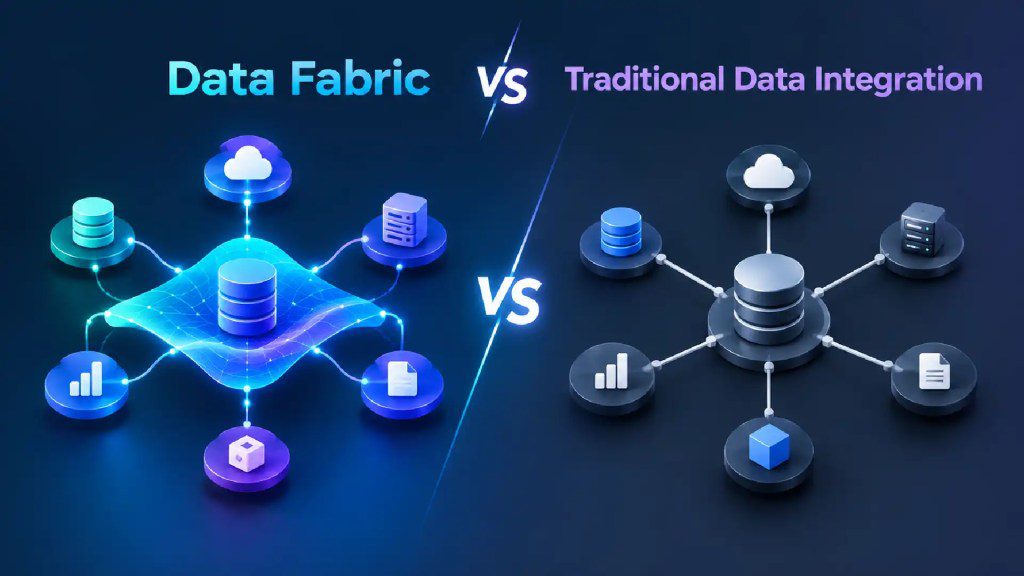
A data fabric approach doesn’t replace ETL, APIs, or warehouses. It adds a metadata-driven architecture layer on top, treating metadata not as documentation written after the fact, but as something the platform actively maintains: where a dataset lives, what it represents, who owns it, and what policies apply to it.
This is where active metadata matters. It goes beyond a static catalog entry, supporting discovery, flagging the downstream impact of a change, or pointing teams toward an existing integration instead of a new one. It doesn’t run governance by itself, but it changes the default question. Traditional integration asks, “How do we move this data?” A data fabric approach asks, “How do we understand, govern, and make this data usable across the enterprise?”
Data Fabric Architecture: What It Looks Like
A practical data fabric architecture has a few recognisable layers: metadata for visibility into datasets and lineage; integration connecting systems that already exist, databases, SaaS apps, warehouses, lakes, lakehouses, streaming platforms; governance for access control and auditing; observability for freshness and pipeline health; and consumption serving BI, applications, and AI agents.
None of this requires buying one platform and replacing the existing estate. An enterprise data fabric is capabilities layered across systems already in production, tied together through shared metadata.
Read More: Modern Data Architecture Principles
Data Fabric Benefits for Enterprise Data Teams
The practical data fabric benefits show up less in how fast data moves and more in the effort required to understand the environment. Teams get better discovery before building, lineage becomes visible instead of tribal knowledge, and impact analysis becomes easier without scattered Slack threads. Governance applies consistently through metadata, existing assets get reused, and AI workloads gain a clearer path to trustworthy data. None of this removes integration work; it reduces time spent rediscovering what should already be known.
Data Fabric vs Data Mesh
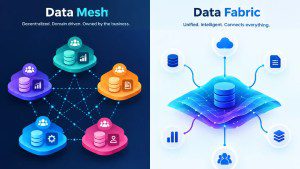
The data fabric vs data mesh question comes up often, since both address a similar problem from different angles. Data fabric is primarily architectural and technological: metadata, integration, discovery, and automated access to distributed data. Data mesh is primarily organisational: domain ownership, data products, and decentralised responsibility for quality.
They aren’t competing choices. An enterprise can apply data mesh principles for ownership while using data fabric capabilities for the underlying metadata and governance infrastructure that makes it workable.
Read More: Data Mesh vs Data Fabric
How Data Fabric Fits With Modern Data Platforms
Data fabric isn’t a storage architecture and doesn’t compete with lakehouses, warehouses, or streaming platforms for that role. It’s the connective layer helping teams find, govern, and access data inside those platforms; the lakehouse still stores and processes the data; the fabric layer makes it easier to know what’s in there and whether it’s current.
Read More: Data Lakehouse Architecture in 2026
Data Fabric Implementation
Data fabric implementation works best as an incremental, business-driven effort rather than one sweeping initiative:
- Inventory current data sources and integration flows.
- Identify the areas causing the most friction.
- Establish metadata and lineage visibility there first.
- Define clear ownership and governance requirements.
- Introduce automation where it delivers measurable value.
- Connect the approach to existing platforms.
- Expand gradually into other high-value domains.
Don’t start by building a complete data fabric across every system at once. Pick a concrete problem- poor discovery, tangled lineage, duplicate integrations- and expand from there. Legacy systems don’t need replacing to begin.
Industry Perspective
Enterprise data environments keep getting more distributed, driven by generative AI, AI agents, and growing SaaS footprints. As data consumers multiply, connectivity alone stops being enough; teams need context, lineage, and discoverability too. The harder an enterprise finds it to answer “where did this data come from, and can I trust it?”, the more valuable metadata becomes as a standalone capability.
FAQs
What is a data fabric? An architectural approach using metadata, automation, and governance to make distributed data easier to discover, connect, and consume, not a single product.
How is data fabric different from traditional data integration? Traditional integration moves data between systems. Data fabric adds metadata, discovery, and governance, shifting focus toward the data’s meaning and trustworthiness.
What are the main data fabric benefits? Better discovery, clearer lineage, more consistent governance, faster impact analysis, and stronger support for analytics and AI.
Conclusion
Data fabric doesn’t ask teams to discard their ETL pipelines, warehouses, or APIs. The real change is how data gets understood, governed, discovered, and connected once metadata becomes active rather than static. For teams facing growing complexity and rising AI-readiness demands, that shift, from moving data to managing its context, is what makes a data fabric approach worth evaluating.