From Copilots to Autonomous Agents: The Rise of Agentic AI in Enterprises
Stay updated with us
Sign up for our newsletter
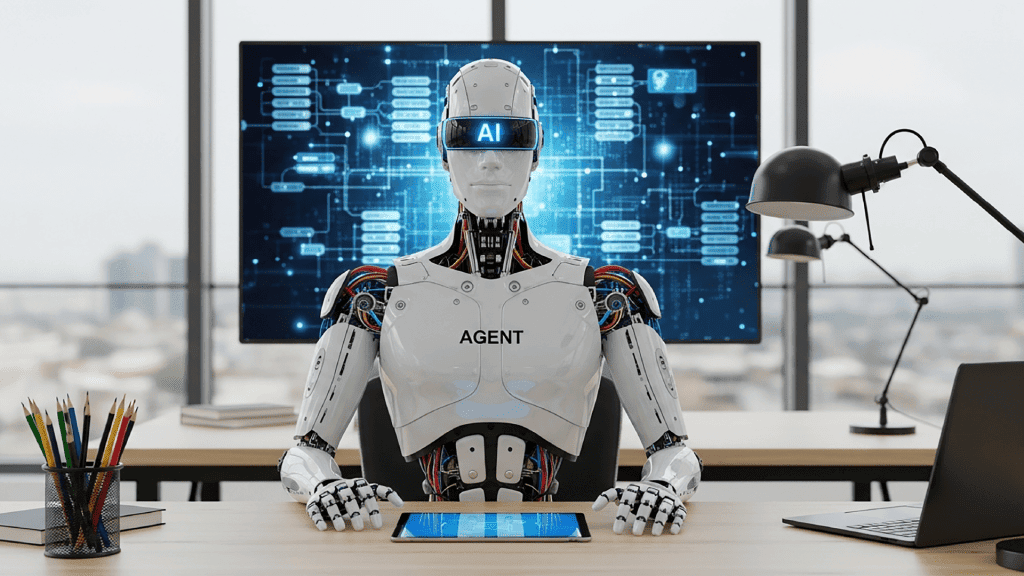
Enterprise AI is entering a new phase. What began as copilots, tools that assist humans with tasks, is rapidly evolving into agentic AI systems capable of planning, executing, and optimizing workflows with minimal human intervention.
For business and technology leaders, this shift marks a critical inflection point. The focus is no longer just on augmenting productivity, but on building autonomous workflows powered by AI agents that can operate across systems, make decisions, and deliver outcomes.
What is Agentic AI in the Enterprise?
Agentic AI refers to systems where AI models act as “agents” that can:
- Understand goals
- Break them into tasks
- Execute actions across tools and systems
- Adapt based on feedback
Unlike traditional AI or copilots, which respond to prompts, AI agents in business environments are proactive. They can initiate actions, collaborate with other agents, and operate continuously.
This is why the term agentic AI enterprise is gaining traction; it represents organizations where workflows are increasingly driven by intelligent agents rather than manual processes.
From Copilots to Agents: What’s Really Changing?
The transition from copilots to agents is not incremental, it is architectural.
Copilots:
- Assist with specific tasks (e.g., writing code, summarizing content)
- Require constant human input
- Operate within a single interface
Agents:
- Execute multi-step workflows independently
- Interact with multiple systems (APIs, databases, tools)
- Make decisions based on context and goals
Key Shift:
From “AI as a tool” → “AI as a system of action”
This evolution is enabling enterprises to move beyond productivity gains toward true operational transformation.
Why Agentic AI is Gaining Momentum Now
Several technological advancements are converging to make agentic AI viable at scale:
1. Advanced LLM Capabilities
Large language models are now capable of reasoning, planning, and contextual understanding, core requirements for agent behavior.
2. Tool Integration Ecosystems
AI models can interact with external tools, enabling them to perform real-world actions such as retrieving data, triggering workflows, or updating systems.
3. Memory and Context Management
Agents can maintain context over longer interactions, allowing them to handle complex, multi-step tasks.
4. Multi-Agent Collaboration
Enterprises are experimenting with multi-agent systems, where multiple AI agents work together to complete tasks more efficiently.
Also Read: AI-Driven SDLC: How AI is Transforming Every Phase of Software Development
Real-World Momentum: Industry Leaders Driving Agentic AI
OpenAI
OpenAI is actively advancing agentic capabilities through its evolving platform ecosystem. Recent developments include:
- More capable multimodal models that can reason across text, code, and tools
- APIs that support tool use and structured outputs
- Increasing focus on enabling developers to build task-oriented AI systems, not just chat interfaces
These advancements are laying the groundwork for autonomous workflows powered by AI.
Anthropic
Anthropic has been focusing on safe and controllable AI systems, which are essential for enterprise adoption of agents. Its recent model updates emphasize:
- Improved reasoning and reliability
- Better alignment with enterprise use cases
- Safer deployment of AI in complex decision-making environments
This focus is particularly relevant as organizations look to deploy AI agents in business-critical workflows.
Leadership Perspective
Sam Altman has repeatedly highlighted the direction AI is heading:
“AI agents that can go off and do things on your behalf will be one of the most impactful shifts in how we use computers.”
(Source: Public interviews and OpenAI discussions on AI agents and future systems)
This perspective reflects a broader industry trend: AI is moving from passive assistance to active execution.
Enterprise Use Cases: Where Agentic AI is Already Delivering Value
Agentic AI is not theoretical; it is already being applied across industries.
1. Customer Support Automation
AI agents can:
- Handle end-to-end customer queries
- Retrieve data from CRM systems
- Escalate complex issues intelligently
2. IT Operations and DevOps
Autonomous agents can:
- Monitor systems
- Detect anomalies
- Trigger remediation workflows
3. Sales and Revenue Operations
Agents can:
- Qualify leads
- Draft outreach
- Update CRM records automatically
4. Knowledge Work Automation
AI agents can:
- Conduct research
- Summarize insights
- Generate reports
In each case, the value lies in reducing manual intervention while maintaining context and accuracy.
Multi-Agent Systems: The Next Layer of Complexity
One of the most important developments in this space is the rise of multi-agent systems in enterprises.
Instead of relying on a single AI agent, organizations are deploying multiple specialized agents that collaborate.
Example Architecture:
- A research agent gathers data
- A planning agent structures the workflow
- An execution agent performs actions
- A validation agent checks outputs
This approach mirrors how human teams operate, but with significantly higher speed and scalability.
Designing Autonomous Workflows with AI
To implement autonomous workflows using AI, enterprises need to rethink process design.
Key Components:
1. Goal Definition
Agents need clear objectives, not just instructions.
2. Tool Access
Integration with enterprise systems (CRM, ERP, APIs) is essential.
3. Memory and Context
Agents must retain and use context across tasks.
4. Governance and Oversight
Human-in-the-loop mechanisms are critical for:
- Risk management
- Compliance
- Quality assurance
Challenges and Considerations
While the potential of agentic AI is significant, there are important challenges to address:
1. Reliability
AI agents must produce consistent and accurate results, especially in critical workflows.
2. Security and Access Control
Agents interacting with enterprise systems require strict governance.
3. Cost Management
Autonomous workflows can increase compute usage if not optimized.
4. Organizational Readiness
Enterprises must adapt processes and roles to integrate AI agents effectively.
Agentic AI vs Traditional Automation
| Traditional Automation | Agentic AI |
| Rule-based | Goal-driven |
| Static workflows | Adaptive workflows |
| Limited scope | Cross-functional execution |
| Human-triggered | Autonomous |
This comparison highlights why agentic AI is seen as a step-change rather than an incremental improvement.
Final Thoughts
The rise of agentic AI represents a fundamental shift in enterprise technology. Organizations are moving from using AI as a productivity tool to deploying it as an operational layer that drives execution.
The implications are significant:
- Workflows become faster and more scalable
- Human roles shift toward oversight and strategy
- Enterprises gain the ability to operate with greater agility
The key question for leaders is not whether agentic AI will impact their organization, but how quickly they can move from copilots to autonomous systems.
FAQs
What is agentic AI in enterprises?
Agentic AI refers to AI systems that can autonomously plan, execute, and optimize tasks within enterprise workflows.
How are AI agents different from copilots?
Copilots assist with tasks, while AI agents can independently complete multi-step workflows and make decisions.
What are autonomous workflows in AI?
Autonomous workflows are processes where AI agents execute tasks across systems with minimal human intervention.