Why the Semantic Layer Is Becoming Critical to AI-Ready Data Architecture
Stay updated with us
Sign up for our newsletter

Enterprise AI can access more data than ever, but access alone does not make data useful. An AI system may retrieve a customer record, revenue figure, or product metric correctly while still misunderstanding what that information means.
That is where the semantic layer is becoming increasingly important.
A semantic layer translates technical data structures into shared business concepts, definitions, relationships, and rules. For AI and analytics, it provides the context needed to interpret data consistently rather than leaving every application, analyst, or AI agent to determine meaning independently.
As enterprises move from traditional analytics to generative and agentic AI, this layer is shifting from a useful analytics capability to an important part of the data architecture.
What Is a Semantic Layer?
A semantic layer is an abstraction between an organization’s underlying data and the applications that consume it.
Instead of requiring users or AI systems to understand technical structures such as database tables, column names, joins, and transformation logic, the semantic layer represents data through familiar business concepts.
For example, an enterprise may have multiple systems containing information about customers, orders, subscriptions, and revenue. The semantic layer can define:
- Customer: the approved business definition of a customer
- Revenue: the calculation and rules used by finance
- Active subscription: the conditions that determine active status
- Product: how products are identified and related across systems
Why Does AI Need a Semantic Layer?
Traditional analytics already benefited from consistent business definitions. AI makes the requirement more pressing.
When an analyst encounters two definitions of “revenue,” they can investigate the underlying queries, speak with finance, or check existing documentation. An AI agent may not have that institutional context. If it is given ambiguous schemas, it may select a technically valid but businessually incorrect interpretation.
This becomes particularly important when AI agents query enterprise systems autonomously.
Gartner warned in May 2026 that insufficient semantic context can make AI agents inaccurate and inefficient because agents need to understand relationships and rules within organizational data.
The issue is therefore not simply data quality. It is also data meaning.
An enterprise can have clean, well-governed data and still produce inconsistent AI results if business definitions are fragmented across applications and teams.
How a Semantic Layer Supports AI-Ready Data
An AI-ready data architecture needs more than storage, pipelines, and governance. It needs a way to connect data with business meaning.
The semantic layer contributes in several ways.
1. Creates Consistent Business Definitions
A semantic data layer can define metrics and business concepts once and make them available across multiple consumers.
For example, instead of allowing different applications to calculate “customer churn” independently, the organization can establish one approved definition and reuse it.
This reduces metric drift and gives AI applications a consistent foundation for answering business questions.
2. Gives AI Business Context
Large language models are capable of interpreting natural language, but they do not automatically understand an organization’s internal terminology.
“Customer,” “revenue,” “qualified lead,” or “active employee” can have very specific meanings within an enterprise.
A semantic layer provides that business context explicitly rather than expecting an AI model to infer it from raw schemas.
This makes the semantic layer for AI particularly relevant to natural-language analytics and enterprise AI assistants.
3. Reduces Dependence on Physical Data Structures
Modern enterprises rarely operate from a single data store. Data may be distributed across warehouses, lakehouses, operational databases, SaaS applications, APIs, and other systems.
A semantic layer can abstract some of this underlying complexity so consumers work with business concepts rather than individual physical sources.
This complements modern architectures that prioritize interoperability rather than forcing every workload into a single platform. For a broader view, see How to Build an AI-Ready Data Architecture for Enterprise AI.
4. Makes AI and Analytics Use the Same Meaning
Historically, semantic models were closely associated with business intelligence and reporting.
That is changing.
The same business definitions may now need to support dashboards, natural-language analytics, AI assistants, data applications, and autonomous agents. A semantic layer for analytics can therefore become a shared foundation rather than a capability tied to one reporting tool.
This is one reason modern semantic architectures are increasingly being discussed as a layer serving both humans and AI systems.
Semantic Layer vs Data Fabric, Data Mesh, and Lakehouse
The semantic layer does not replace other modern data architecture approaches. It addresses a different problem.
| Architecture | Primary focus |
| Data lakehouse | Storage, processing, analytics, and AI workloads |
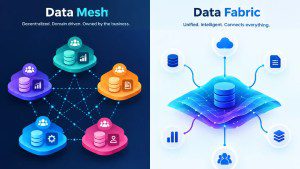
| Data fabric | Connecting, integrating, discovering, and governing distributed data |
| Data mesh | Decentralized data ownership and domain-oriented data products |
| Semantic layer | Shared business meaning, definitions, metrics, and relationships |
These approaches can work together.
A lakehouse may provide the underlying data platform. A data fabric can connect distributed sources. Data mesh principles can establish ownership within business domains. The enterprise semantic layer can then provide a consistent business interpretation across those environments.
For a deeper comparison, see Data Mesh vs Data Fabric and Data Lakehouse Architecture in 2026.
What Does a Modern Semantic Architecture Include?
A mature semantic architecture typically brings together several elements:
Business definitions: Standard meanings for metrics, entities, dimensions, and key terms.
Relationships: Connections between entities such as customers, products, orders, employees, and accounts.
Business logic: Approved calculations, filters, classifications, and rules.
Metadata: Information about data sources, ownership, lineage, and definitions.
Governance: Controls that determine who can access particular data and how it can be used.
Access mechanisms: Interfaces through which BI tools, applications, APIs, and AI systems can consume the semantic model.
How Should Enterprises Build a Semantic Layer?
A semantic layer should not become another isolated data project.
Enterprises can begin with a limited set of high-value business concepts that are already creating inconsistencies. Revenue, customer, product, employee, inventory, and churn are common examples.
The next step is to establish ownership for those definitions and map them to the underlying data sources. Data teams can then expose the approved definitions to analytics and AI applications.
The model should also be versioned and governed. When the business definition changes, the organization needs to know who approved the change, which systems depend on it, and how that change affects downstream AI applications.
This incremental approach fits the broader principle of modern data architecture: modernize where it creates measurable value rather than replacing working systems simply because newer technologies exist. Read Modern Data Architecture Principles Every Enterprise Should Follow in 2026 for the broader architectural framework.
What Changes With Agentic AI?
The importance of semantics increases when AI moves from answering questions to taking actions.
An AI assistant that reports revenue incorrectly creates a trust problem. An AI agent that uses an incorrect customer definition to trigger a workflow can create an operational problem.
Agentic systems need to understand not only what data says, but also what business concepts mean, how entities relate, and which rules apply.
That makes the semantic layer part of the control surface between enterprise data and AI-driven actions.
The goal is not to make AI understand every detail of the enterprise. It is to make the meaning of the data that AI is allowed to use explicit, governed, and reusable.
Write to us [wasim.a@demandmediaagency.com] to learn more about our exclusive editorial packages and programmes.