
IT Tech Pulse Exclusive Interview with Alec Buchenic, Vice President at Martinwolf
Stay updated with us
Sign up for our newsletter
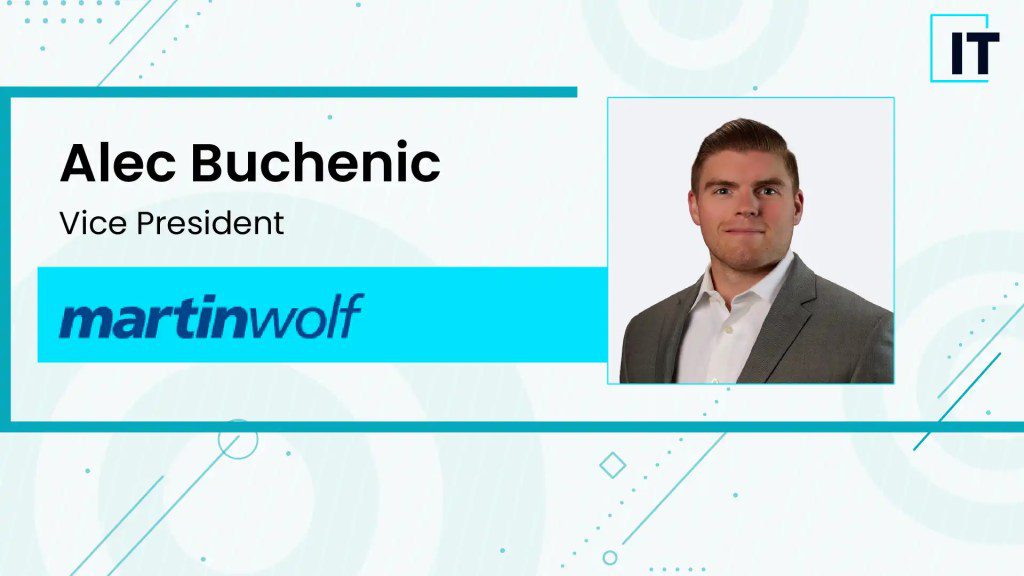
In this exclusive interview, Alec Buchenic, Vice President at martinwolf, discusses IT services M&A, business valuation, recurring revenue, and AI’s impact on MSPs. He also shares what founders can do to build stronger businesses and attract greater buyer interest.
Alec, before martinwolf, you supported KeyBanc deals in distribution and business services. Coming to an IT-only firm, what did that broader lens teach you about judging technology businesses specialists might miss?
Working across distribution and business services before focusing on IT taught me that while every sector has its own vocabulary, the same fundamental, underlying questions still apply:
- How much does the business depend on the owner?
- How durable is the revenue?
- How transferable are the customer relationships?
- How much of the margin survives a change in ownership?
When you’ve seen those questions answered across several different industries, you stop being impressed by sector-specific signals and start testing them. In IT services, the signals that can anchor a specialist are recurring revenue percentage, vendor certifications, and the tool stack.
However, these signals are only inputs and need context to be valuable. Recurring revenue is only as valuable as its retention, the cost to deliver the service, and the contracts. A certification is only worth what customers pay for it, and a great stack doesn’t fix weak customer-level margins.
Taking this broader lens also gives you a wider set of comparisons. Many of the operating metrics that matter for an MSP, such as utilization, customer concentration and contract structure, show up in other service businesses, and seeing how buyers underwrite them elsewhere makes it easier to spot where an IT business is stronger or weaker than its story suggests.
You have advised sellers like GuideIT and WebSan and buyers like CMIT Solutions and Celestica. Where do IT owners most often misjudge what makes their business valuable once diligence starts?
Owners tend to value what they built, while buyers value how durable and transferable the cash flow is. This gap usually shows up in the same handful of places:
- Customer Concentration: A single customer accounting for a significant percentage of revenue (typically +15%) will always draw scrutiny, regardless of how long the relationship has been in place
- Contracts: Month-to-month arrangements, missing autorenewals, and services that are assumed rather than contracted all get discounted by potential buyers.
- Owner Dependency: If the founder owns the key relationships and all of the selling, the buyer has to price in the risk that the founder walks out the door after the sale. This is often one of the hardest gaps to fix.
- Revenue Quality: Buyers place a premium on predictable, recurring revenue. Multi-year contracted revenue is valued differently than project-based work or revenue generated from hardware and software resale.
- EBITDA Adjustments: Adjusted EBITDA often looks different under buyer scrutiny. The quality of earnings (“QoE”) process tests whether proposed adjustments are truly sustainable and whether the strengths of the business are reflected in the numbers.
Acture and Digital BackOffice both serve schools, and you cited cross selling. How can a buyer tell whether shared K-12 customers create value or merely look convincing in a deal thesis?
Cross-selling opportunities only materialize when there is a real gap to fill and a reason for the customer to choose your company.
Start with what the overlapping districts actually buy from each company. If they’re buying connectivity and network infrastructure from one company and managed IT and security from the other, then there is a genuine wallet-share opportunity. However, if they’re only purchasing the same product or service, it’s a consolidation, not cross-sell scenario.
The next consideration is whether the procurement environment supports that opportunity. K-12 budgets run on annual cycles and are subject to E-Rate and RFP requirements, so the path from a shared customer to incremental revenue should be evaluated against those timelines. It is also important to understand whether either company has already expanded its relationship with those districts organically.
Finally, cross-selling opportunities should be underwritten as upside rather than part of the base case. If the deal depends on those opportunities materializing in order to generate returns, that is often a sign that the underlying thesis lacks sufficient stand-alone strength.
In the case of Acture and Digital BackOffice, the complementary capabilities and adjacent geographies made the opportunity concrete rather than theoretical.
In January you expected more IT assets to reach market and close. AI uncertainty has since delayed buyer decisions. How has that changed what sellers must prove before buyers commit?
The volume we expected in January has largely shown up, as more assets have come to market and deals have continued to close. What has changed is that buyers are demanding a much clearer answer to how AI affects both the durability of the revenue stream and the future earnings power of the business. As a result, buyers have become far more selective, raising the burden of proof and widening the gap between the most attractive assets and the rest of the market.
The first question in almost every process now is: What does AI mean for this business? With buyers raising the burden of proof, it’s no longer enough to simply have an AI story. Sellers need to show, through margins, productivity, staffing efficiency, and other operating metrics, how AI is shaping the company’s competitive position and future earnings potential. This includes being able to answer:
- Which revenue streams are exposed to AI-driven deflation, such as help desk, Level 1 support, or ticket-volume-based pricing?
- Which revenue streams are more insulated, such as infrastructure, cybersecurity, compliance, and relationships in regulated end markets?
- How is the company using AI internally, and is there evidence of that in margin expansion, productivity gains, or staffing ratios?
- Are the pricing models durable in an AI-driven environment, with recurring per-user or outcome-based revenue, or are they more dependent on transaction- or ticket-based pricing that may face greater scrutiny?
You told Channel Dive that MSPs should treat security as a core offering, not an add-on. Beyond security, which capabilities will buyers increasingly demand from MSPs in coming years?
Compliance delivered as a service is the obvious next layer, particularly for customers in education, healthcare, financial services, and government. That includes documentation, reporting, cyber insurance readiness, and alignment with regulatory and security frameworks.
Close behind is AI enablement. SMB customers want help adopting these tools safely, which require capabilities around data governance, identity management and policy. The MSPs that can package all of these services into a single cohesive offering will be well-positioned to own the next budget line.
Buyers are increasingly seeking MSPs that can serve as a single accountable partner and trusted advisor, rather than just a vendor. That means owning more of the technology stack, such as connectivity, network infrastructure and cloud, alongside managed IT. Strategic advisory, CIO capabilities, and cloud cost management offerings turn an MSP into a value-add partner.
The common thread here is that buyers want MSPs that own outcomes rather than tickets, and that have the vertical depth to prove it.
Make a prediction: by 2029, will specialized regional MSPs like Digital BackOffice command valuation premiums over larger generalists, or will AI-driven delivery economics let scale win again?
Specialists will win, but with one important caveat, specialization alone won’t be enough.
AI lowers the cost of delivery for everyone, compressing the generalist’s cost advantage far more than the specialist’s relationship advantage. A regional MSP with density in a regulated vertical, a strong local presence, and a clear value proposition, will likely continue to command a premium relative to its size in 2029, and I expect that gap to widen.
However, at the platform level, scale will still likely win, with the larger providers commanding the highest absolute multiples. But those platforms will increasingly have to pay up to acquire specialists with differentiated capabilities, customer relationships, or market positions.
The group most at risk is the mid-sized generalist with no vertical expertise or geographic edge, competing on price against larger players with better AI-driven economics. The specialists that earn the premium will be the ones that have niche expertise and have adopted AI-enabled offerings, bringing both the margin profile and moat that buyers are looking for.
You wrote about strategic buyers versus private equity. Whichever route owners take, what should an MSP founder start doing this year to build a business any buyer wants?
- Manage Financials and KPIs: It’s the first thing any buyer will look at, so you need timely monthly closes, with clear revenue reporting and gross margins delineated by customer and by service line, as well as add-backs you can defend.
- Prioritize Recurring Revenue: It commands a higher multiple than one-time projects or hardware/software resale. Focus on moving customers onto multi-year agreements with autorenewals and annual escalators. Equally important is making sure you have contracts with all customers, and ensure they are actually three-year contracts (no 30-day out clauses).
- Reduce Owner Dependency: Make sure to build a second layer of management and ensure the founder isn’t the only person who sells or owns the relationships.
- Manage Customer Concentration: Keep any single customer under 15% of revenue and your top 10 customers under 50% of revenue. Tenure is important for showing that customers stay and you do not have a lot of churn, which otherwise could imply negative things about the business and delivery.
- Standardize the Stack and Document Processes: This is so the buyer can see how the business integrates.
- Specialize: Developing a deep understanding for a smaller number of verticals will differentiate you from the generalists.
Most importantly, you need to start early. These are not processes that can be completed in 12 months. Many owners do not think about these aspects until they are preparing to sell, but they should be considered and acted on as the business is being built so the company is positioned for an exit when the right time comes.
Thank you so much, Alec, for participating in our IT Tech Pulse Interview series. We look forward to having you and martinwolf leaders again!
Write to us [editorial@demandmediaagency.com] to learn more about our exclusive editorial packages and programmes.
Alec Buchenic is a Vice President at martinwolf, where he leads and supports the execution of M&A transactions, with expertise in managed IT services, IT systems integrators, and IT solution providers. Since joining the firm in 2023, he has led or supported more than 15 transactions, including sell-side engagements for clients such as GuideIT, WebSan Solutions, StepUp Consulting, and Digital BackOffice, as well as buy-side engagements for clients including Celestica, Companial, and CMIT Solutions.
Before joining the firm, he worked at KeyBanc Capital Markets in its M&A product group, where he served as lead support on more than 10 M&A transactions in the distribution and business services industries. He holds a B.S. in Finance from John Carroll University and a Master’s in Corporate Finance from Case Western Reserve University and is a FINRA-registered broker.
Martinwolf is a leading M&A advisory firm specializing in IT cloud/tech-enabled services, software/SaaS, and IT supply chain. A trusted partner to IT business owners and buyers, the firm has advised on approximately 300 transactions in ~20 countries, including eight divisions of Fortune 500 companies. martinwolf brings a strong personal commitment to every client and is relentless in its pursuit of the right outcome. Registered member of FINRA & SIPC.