

Data Lakes vs Data Warehouses vs Lakehouse: A Strategic Comparison
Stay updated with us
Sign up for our newsletter
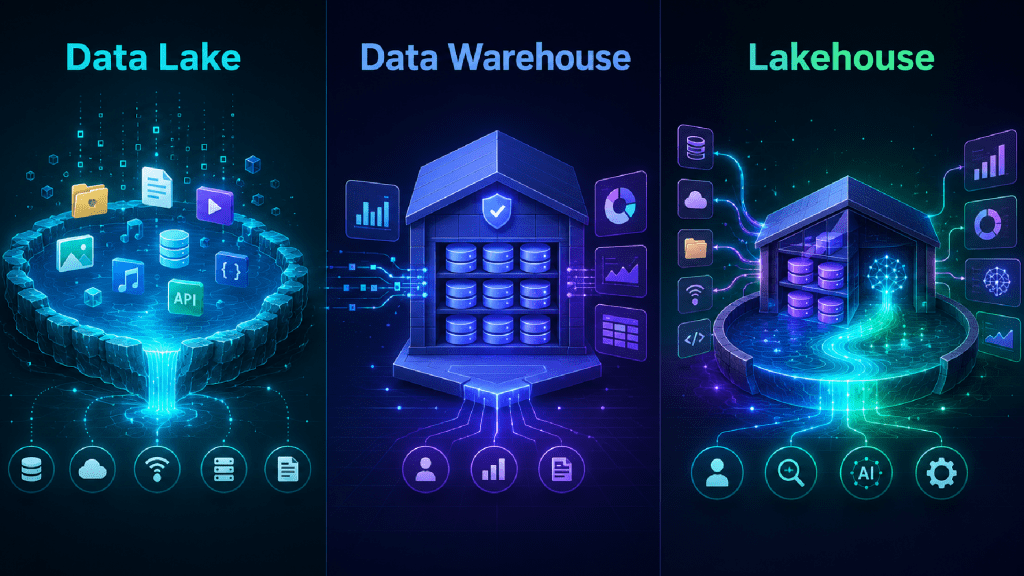
If there’s one decision that quietly shapes every data strategy, it’s this:
Where does your data live, and how is it used?
For years, enterprises approached this as a binary choice: data lake vs data warehouse. One prioritised flexibility, the other structure.
But as data volumes exploded and AI use cases matured, that binary broke down. Organizations didn’t just need storage; they needed systems that could support both exploration and reliability.
That’s where the lakehouse architecture enters the conversation.
Why This Debate Exists in the First Place
The tension between data lakes and data warehouses comes from competing priorities.
- Business teams want clean, reliable, structured data
- Data teams want flexibility to explore raw, diverse datasets
Early systems forced a trade-off. You chose control or adaptability, but rarely both.
Modern data storage solutions for enterprises are trying to eliminate that trade-off.
Data Warehouses: Built for Structure and Trust
Data warehouses were designed for one thing: consistent, reliable analytics.
They store structured data that has already been cleaned, transformed, and validated. By the time it reaches the warehouse, it’s ready for reporting.
What makes warehouses effective:
- Strong schema enforcement
- High query performance
- Trusted, single source of truth
Platforms like Snowflake have modernised this model by moving warehouses to the cloud. This introduced scalability and flexibility without losing structure.
Where warehouses work best:
- Business intelligence and reporting
- Financial analysis and compliance
- Operational dashboards
The trade-off is flexibility. Warehouses are not designed for raw or unstructured data. Every change requires transformation upfront, which can slow experimentation.
Data Lakes: Built for Scale and Flexibility
Data lakes emerged as a response to those limitations.
Instead of enforcing structure early, lakes allow you to store raw data in its native format—structured, semi-structured, or unstructured.
What makes lakes powerful:
- Massive scalability
- Low-cost storage
- Ability to store diverse data types
This makes them ideal for:
- Machine learning workflows
- Data exploration
- Large-scale ingestion
But flexibility comes at a cost.
Without governance, data lakes can quickly turn into data swamps—unstructured, inconsistent, and hard to trust.
This is the core challenge in the data lake vs warehouse debate:
- Lakes give you freedom
- Warehouses give you control
Also Read: ETL vs ELT: What’s Right for Modern Data Pipelines?
Lakehouse Architecture: Bridging the Gap
The lakehouse architecture is an attempt to combine the best of both worlds.
It keeps the flexibility and scalability of data lakes while introducing the structure and performance of data warehouses.
Instead of maintaining separate systems, the lakehouse creates a unified platform where:
- Raw and processed data coexist
- Schema enforcement is applied when needed
- Analytics and machine learning run on the same data layer
Companies like Databricks have been central to this approach, positioning the lakehouse as the next evolution of enterprise data architecture.
How the Differences Actually Play Out
On paper, the distinctions are simple. In practice, they reshape how teams work with data.
Data Warehouses:
- Data is transformed before storage
- Designed for structured queries
- Best for business reporting
Data Lakes:
- Data is stored in raw form
- Designed for flexibility and scale
- Best for exploration and ML
Lakehouse:
- Combines raw and structured data
- Supports both analytics and AI workloads
- Reduces duplication across systems
The shift toward lakehouse isn’t about replacing existing systems—it’s about reducing fragmentation.
Why Enterprises Are Moving Toward Lakehouse
The biggest challenge in modern data environments isn’t storage—it’s fragmentation.
When lakes and warehouses operate separately:
- Data gets duplicated
- Pipelines become complex
- Governance becomes inconsistent
Lakehouse architecture simplifies this by creating a single data foundation.
This is especially important for AI-driven businesses, where:
- Models need access to both raw and curated data
- Data pipelines must scale efficiently
- Teams need to collaborate across use cases
The Role of Cloud in This Evolution
Cloud platforms have played a critical role in making all three models viable at scale.
- Warehouses became more scalable and cost-efficient
- Lakes became easier to manage
- Lakehouse architectures became technically feasible
Platforms like Snowflake are also evolving toward unified data ecosystems, while Databricks continues to push lakehouse adoption.
This convergence is shaping the future of enterprise data storage solutions.
Choosing the Right Approach
There’s no universal answer to data lake vs warehouse vs lakehouse. The right choice depends on your priorities.
Choose a Data Warehouse if:
- You need highly structured, reliable reporting
- Compliance and governance are critical
- Your data types are mostly structured
Choose a Data Lake if:
- You’re handling large volumes of diverse data
- You need flexibility for experimentation
- Machine learning is a key focus
Choose a Lakehouse if:
- You want to unify analytics and AI workloads
- You’re trying to reduce data silos
- You need both flexibility and governance
In reality, many enterprises don’t fully replace one with another—they evolve toward a hybrid or lakehouse-driven model over time.
Common Mistakes to Avoid
Treating It as a Technology Decision
This is an architectural choice, not just a tooling one.
Ignoring Governance in Data Lakes
Flexibility without control leads to unusable data.
Overcomplicating the Stack
More systems don’t always mean better outcomes.
Expecting One System to Solve Everything
Different workloads still require different optimisations.
The Bigger Shift: From Storage to Strategy
This conversation is no longer just about where data is stored.
It’s about how data is:
- Accessed
- Trusted
- Used across the organisation
Modern enterprises are moving from isolated storage systems to integrated data ecosystems.
A Practical Way Forward
If you’re evaluating your architecture:
- Start with your use cases, not your tools
- Identify where flexibility or control matters most
- Build toward unification gradually
Lakehouse architecture doesn’t require a complete rebuild. It can be adopted incrementally, aligning with business needs.
Conclusion
At some point, the debate between data lakes, data warehouses, and lakehouse architecture stops being theoretical.
It becomes a question of how effectively your organization can use data.
If your systems are fragmented, insights slow down.
If your data isn’t trusted, decisions weaken.
The goal isn’t to pick a winner.
It’s to design a system that supports both scale and reliability—without forcing a trade-off.
Frequently Asked Questions
Is lakehouse replacing data warehouses?
Not entirely. It’s extending their capabilities while reducing the need for separate systems.
Can data lakes and warehouses coexist?
Yes. Many enterprises still use both, especially during transition phases.
When should we adopt a lakehouse architecture?
When data silos, duplication, or AI use cases start creating friction in your current setup.
What’s the biggest mistake teams make?
Choosing a platform before defining their data strategy.