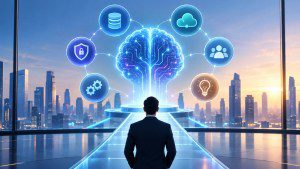
How AI Is Transforming Cybersecurity Operations
Stay updated with us
Sign up for our newsletter
Enterprise cybersecurity operations were designed for environments that were smaller, slower, and more predictable. Today’s reality is fundamentally different. Cloud platforms, SaaS adoption, remote access, and identity-based architectures have expanded the attack surface far beyond what traditional SOC models were built to manage.
Most security operations still rely on rule-based detection, static thresholds, and manual investigation workflows. These approaches generate overwhelming alert volumes, much of it low-quality or redundant. Analysts are forced to triage thousands of signals daily while juggling multiple tools that rarely share context. As a result, real threats are often identified late, after attackers have already established persistence.
The problem is not a lack of tools, but a lack of scalable intelligence. Human-driven analysis does not scale linearly with data growth, and signature-based controls struggle against credential abuse, living-off-the-land techniques, and novel attack patterns. This gap between operational demand and human capacity is where traditional cybersecurity operations are reaching their practical limits.
What AI Changes in Modern Cybersecurity Operations
AI introduces a structural shift in how security operations function. Instead of relying on predefined rules and manual correlation, AI systems continuously analyse large volumes of telemetry to identify patterns, relationships, and anomalies.
Read more: Enterprise Cyber Threats in 2026: What CIOs and CISOs Must Prepare For
In modern cybersecurity operations, AI acts as an intelligence layer across detection, investigation, and response. It correlates signals across endpoints, networks, identities, and cloud workloads in near real time. More importantly, it learns from historical incidents and adapts as environments and attacker techniques change.
This changes the role of the SOC. Analysts shift their focus from repetitive alert handling to validation, decision-making, and response oversight. AI does not replace human judgment, but it removes the operational bottlenecks that slow investigations and increase risk. This shift is central to AI in Cybersecurity Operations, becoming a necessity rather than an optimisation.
AI-Driven Threat Detection Beyond Signature-Based Security
Traditional detection relies heavily on known indicators and signatures. While effective for previously identified threats, this approach breaks down when attackers modify tools, reuse legitimate credentials, or exploit misconfigurations.
AI-driven threat detection focuses on behaviour rather than static indicators. Machine learning models establish baselines of normal activity for users, devices, and applications. When deviations occur, such as unusual access patterns, abnormal data movement, or unexpected process behaviour, AI flags them for investigation.
This approach is particularly effective against zero-day attacks, insider threats, and lateral movement. Instead of waiting for threat intelligence updates, AI identifies suspicious behaviour as it unfolds. Detection becomes adaptive and context-aware, reducing reliance on constant rule tuning and manual oversight.
The Role of Machine Learning in Cybersecurity Operations
Machine learning underpins most AI-enabled security capabilities. Supervised learning models classify known threats based on historical data, supporting malware detection and phishing analysis. Unsupervised learning models identify anomalies in unlabeled data, making them valuable for detecting unknown or emerging threats.
In real SOC workflows, machine learning models are applied to log analysis, user behaviour analytics, network traffic inspection, and endpoint telemetry. These models continuously refine their understanding of what is normal and what is risky within a specific enterprise environment.
Over time, this enables more accurate prioritisation and fewer false positives. Instead of alerting on every deviation, machine learning models evaluate context, asset criticality, and historical behaviour. This practical application of machine learning in cybersecurity allows SOC teams to focus on events that genuinely warrant attention.
Read more: How Zero Trust Security Reduces Blast Radius During Active Breaches
Cybersecurity Automation with AI in the Security Operations Centre
Alert overload remains one of the most persistent challenges in security operations. AI addresses this through automation that extends beyond basic scripting.
Cybersecurity automation with AI enables the SOC to automatically correlate alerts, enrich incidents with contextual data, and execute predefined response actions. For example, AI-driven workflows can gather endpoint data, validate indicators, and assess risk before an analyst ever reviews the case.
This automation reduces manual effort and improves consistency. Response actions such as account suspension, endpoint isolation, or access restriction can be executed quickly and uniformly, reducing the window of exposure. Automation does not eliminate analyst involvement, but it ensures that human effort is applied where it adds the most value.
How AI Improves SOC Efficiency at Enterprise Scale
Enterprise SOCs face scale challenges that smaller organisations do not. Global operations, multiple cloud environments, and regulatory requirements create complexity that cannot be managed through staffing alone.
Using AI to improve SOC efficiency allows organisations to scale operations without proportional increases in headcount. AI systems handle repetitive analysis, reduce duplicate alerts, and surface high-confidence incidents. This enables existing teams to manage larger environments more effectively.
AI-powered security operations (SOC) models also improve consistency across shifts and regions. Decisions are informed by the same data and logic regardless of time zone or analyst experience. This reduces operational risk and improves response reliability across the enterprise.
AI for Real-Time Threat Detection and Response
Speed is critical during active incidents. Delayed detection allows attackers to escalate privileges, move laterally, and exfiltrate data.
AI for real-time threat detection and response enables continuous monitoring and immediate action. AI systems analyse streaming data and respond as suspicious behaviour emerges, rather than after manual review. Automated containment actions can limit impact while analysts investigate further.
This real-time capability is particularly valuable in ransomware and credential-based attacks, where minutes can determine the scale of damage. AI-driven response reduces dwell time and helps contain incidents before they disrupt core business operations.
Benefits of AI in Enterprise Cybersecurity
The benefits of AI in enterprise cybersecurity extend beyond faster detection. Organisations adopting AI-driven security operations typically experience improved visibility, better prioritisation, and more resilient response processes.
AI reduces false positives, allowing teams to focus on meaningful threats. It improves scalability, enabling consistent security across complex environments. It also supports proactive defence by identifying patterns that indicate emerging risks.
Most importantly, AI allows security teams to shift from reactive fire-fighting to controlled, intelligence-driven operations that align more closely with business risk management.
Limitations and Challenges of AI-Driven Security Operations
Despite its advantages, AI introduces new challenges. AI models depend on high-quality data, and incomplete or biased inputs can affect accuracy. Integration with legacy systems can be complex, requiring careful planning and engineering effort.
Explainability is another concern. Security leaders must understand why AI systems make certain decisions, particularly in regulated environments. Human oversight remains essential to validate findings and manage exceptions.
AI systems are also targets themselves. Adversarial techniques aimed at evading or manipulating models are an emerging risk. Effective governance, monitoring, and continuous tuning are required to ensure AI enhances security rather than introducing new weaknesses.
The Future of Cybersecurity Operations in an AI-Driven Era
As threat activity continues to increase in volume and sophistication, containment and operational resilience will matter more than absolute prevention. AI will play a central role in enabling this shift.
Future cybersecurity operations will rely on AI to continuously adapt, correlate, and respond across distributed environments. Security teams will focus on governance, strategy, and high-impact decisions, while AI handles scale and speed.
This evolution aligns with broader Enterprise cyber threats shaping security planning in 2026 and beyond. Organisations that integrate AI thoughtfully into their security operations will be better positioned to manage risk in an environment where manual approaches are no longer sufficient.
Conclusion
AI is no longer an experimental addition to cybersecurity operations. It has become a practical response to the scale, speed, and complexity of modern threats. By augmenting detection, investigation, and response with machine-driven analysis, organisations can reduce operational friction and improve consistency across their security programs. AI enables security teams to focus on decisions that matter most, rather than being consumed by alert volume and manual processes. At the same time, successful adoption requires discipline, strong data foundations, clear governance, and continuous human oversight. As enterprises plan for the next phase of cybersecurity maturity, AI will increasingly define how effectively security operations balance speed, accuracy, and resilience in an environment where traditional approaches can no longer keep pace.