Choosing the Right Data Engineering Tools Stack in 2026
Stay updated with us
Sign up for our newsletter

The modern data stack is becoming harder to simplify.
A few years ago, most enterprises could define their architecture in relatively simple terms:
- A warehouse
- An ETL tool
- A reporting layer
That model no longer reflects reality.
In 2026, enterprise data ecosystems include:
- Real-time streaming pipelines
- AI and generative AI systems
- Cloud-native warehouses
- Distributed governance models
- Metadata platforms
- Feature engineering systems
- Observability layers
The challenge is no longer only collecting data.
It is choosing a data engineering tools stack that can scale operationally, financially, and architecturally as business complexity grows.
This is why organizations are moving away from isolated tooling decisions and toward platform-oriented thinking.
Why Tool Selection Became More Complex
Modern enterprises operate across:
- Multi-cloud environments
- SaaS ecosystems
- AI workloads
- Distributed teams
- Real-time pipelines
As a result, tooling decisions now directly affect:
- Scalability
- Governance
- Cost optimization
- AI readiness
- Operational resilience
This is also why conversations around scalable data pipelines for enterprise growth increasingly focus on ecosystem compatibility rather than standalone features.
The strongest stacks are not necessarily the ones with the most tools.
They are the ones that integrate effectively.
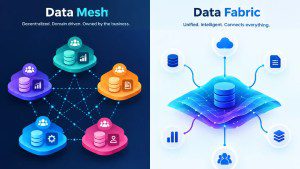
Read More: What Is the Future of Data Architecture: Data Mesh or Data Fabric?
The Modern Data Engineering Stack Is Becoming AI-Centric
The rise of AI and generative AI has significantly reshaped tooling priorities.
Enterprises now need tools that support:
- Real-time ingestion
- Metadata visibility
- Feature engineering
- Governance automation
- Scalable cloud processing
- AI workload orchestration
This directly connects to the growing importance of data engineering for AI and machine learning success, where infrastructure quality directly impacts model performance.
Modern tooling is no longer built only for analytics.
It is increasingly designed for AI-native operations.
The Shift Toward Unified Architectures
Tool fragmentation creates operational pressure.
Different teams often adopt:
- Separate ingestion platforms
- Independent transformation tools
- Duplicate storage systems
- Isolated governance layers
Over time, that creates:
- Rising cloud costs
- Governance gaps
- Duplicate pipelines
- Data inconsistencies
This is why enterprises are increasingly aligning tooling decisions with broader architectural strategies such as:
- lakehouse architecture and modern data storage models
- future-ready data architecture approaches like Data Mesh and Data Fabric
Tooling decisions now shape long-term architecture flexibility.
Governance Is Becoming a Tooling Requirement
Governance used to sit outside the tooling layer.
That is changing quickly.
Modern enterprises expect tooling ecosystems to support:
- Metadata visibility
- Access controls
- Data lineage
- Compliance automation
- Observability
- AI governance readiness
This evolution reflects the broader shift toward modern enterprise data governance frameworks, where governance becomes embedded directly into operational systems.
The future stack is not only scalable.
It is governed by design.
What Modern Data Engineering Stacks Need in 2026
Before selecting tools, enterprises should evaluate whether their stack supports:
- Batch and streaming workloads
- AI and generative AI systems
- Elastic cloud scaling
- Metadata and lineage visibility
- Real-time observability
- Cross-platform integration
- Cost optimization controls
- Governance automation
The goal is interoperability—not just functionality.
5 Leading Data Engineering Tools Enterprises Are Prioritizing in 2026
1. Databricks
Databricks has become central to modern lakehouse architecture strategies.
Why enterprises use it:
- Unified analytics and AI workloads
- Lakehouse architecture support
- Scalable machine learning infrastructure
- Strong cloud-native performance
Best suited for:
- AI-driven enterprises
- Large-scale analytics
- Generative AI environments
2. Snowflake
Snowflake continues to dominate enterprise cloud data warehousing while expanding into AI and application ecosystems.
Why enterprises use it:
- High-performance cloud warehousing
- Elastic compute scaling
- Secure data sharing
- Cross-cloud flexibility
Best suited for:
- Enterprise analytics
- Scalable BI environments
- Multi-cloud strategies
3. Confluent
Built around Apache Kafka, Confluent has become a major platform for real-time data engineering.
Why enterprises use it:
- Event-driven architecture support
- Real-time streaming pipelines
- Low-latency processing
- Distributed scalability
Best suited for:
- Streaming analytics
- AI inference pipelines
- Real-time enterprise systems
4. dbt Labs
dbt Labs helped modernize transformation workflows by bringing software engineering practices into analytics engineering.
Why enterprises use it:
- SQL-first transformations
- Modular pipeline development
- Version-controlled workflows
- Strong developer collaboration
Best suited for:
- ELT-driven environments
- Analytics engineering teams
- Cloud-native transformation workflows
5. Collibra
Collibra remains a leading governance and metadata management platform.
Why enterprises use it:
- Metadata visibility
- Data lineage tracking
- Governance automation
- Compliance management
Best suited for:
- Regulated industries
- Enterprise governance environments
- Large-scale metadata operations
The Biggest Mistake Organizations Make
Many enterprises still select tools based on:
- Vendor popularity
- Feature lists
- Short-term project needs
But tooling decisions should reflect:
- Long-term architecture goals
- Governance maturity
- AI readiness
- Scalability requirements
- Operational complexity
The strongest stacks are ecosystems, not isolated products.
Industry Perspective: Different Industries Prioritize Different Stacks
Financial Services
Focus on governance, lineage, security, and real-time monitoring.
Healthcare
Prioritize compliance, interoperability, and secure AI infrastructure.
Retail and E-Commerce
Emphasize personalization, streaming analytics, and customer intelligence.
SaaS and Technology
Need scalable AI infrastructure, observability, and distributed architecture support.
Different industries optimize differently, but flexibility and governance are becoming universal requirements.
A Practical Framework for Choosing the Right Stack
Organizations modernizing their stack should evaluate:
- Business dependency on AI
- Real-time processing requirements
- Governance maturity
- Cloud architecture strategy
- Pipeline scalability needs
- Metadata visibility requirements
- Cost optimization goals
Tool selection should follow architecture—not the other way around.
The Bigger Shift: Data Engineering Stacks Are Becoming Operational Platforms
The modern data stack is no longer only an analytics foundation.
It is becoming:
- An AI infrastructure layer
- A governance framework
- A real-time operational system
- A business intelligence ecosystem
This is how modern data architecture is evolving in 2026.
The organizations that scale successfully will not necessarily use the most tools.
They will use the most connected ones.
Conclusion
At some point, choosing a data engineering stack stops being a technology procurement exercise.
It becomes a business architecture decision.
The tools enterprises adopt today will influence:
- AI scalability
- Governance maturity
- Operational efficiency
- Cloud economics
- Decision-making speed
The future-ready data stack is not defined by a single platform.
It is defined by how effectively the ecosystem works together.
FAQs
What is the most important factor when choosing a data engineering stack?
Interoperability. Modern systems must integrate across analytics, AI, governance, and cloud environments.
Are unified platforms replacing specialized tools?
Not entirely. Most enterprises still use ecosystem-based architectures with specialized components.
How is AI changing tooling priorities?
AI increases demand for scalable processing, metadata visibility, real-time infrastructure, and governance automation.
What is the biggest mistake organizations make?
Choosing tools before defining long-term architecture, governance, and operational requirements.