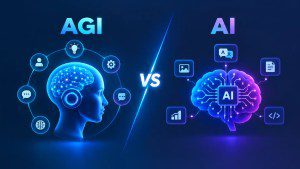
How Would AGI Work? The Technology Behind Artificial General Intelligence
Stay updated with us
Sign up for our newsletter

The concept of artificial general intelligence (AGI) is usually understood to be an advanced form of AI that carries out various complex activities instead of specializing in one task. However, what needs to happen for that to take place? Can it be achieved with a more complex language model and computing approach, or will unique technologies have to work together?
It is unlikely that any single model can accomplish that. An AGI platform would need to analyze information, solve a novel problem, plan its next steps, learn from its experience, evaluate the success of its actions, and so on.
Joint achievement of all these possibilities is not something we can do today. However, AI research today brings us some hints on some components that researchers look into.
Our article on the differences between AI, generative AI, and agentic AI explains how they rely on different capabilities. Achieving AGI will mean having the ability to adapt much more broadly.
The Core Components of an AGI System
There is no generally accepted architectural template for AGI. However, it can be helpful to look at the functions that will be necessary in order to achieve it.
1. Foundation Models: Starting Point
The term foundation model refers to the model that is used to process the information and carry out the specific tasks. For instance, large language models (LLM) learn patterns from large amounts of text and other training data to produce replies, write code, summarize information and solve problems.
Though such a model is a good starting point, having some knowledge does not guarantee general intelligence. A model that was able to perform the task in one situation may fail to do so in another.
2. Reasoning: Working Through Problems
Reasoning allows the AI system to go beyond just giving an instant answer since it enables it to divide a complex situation into smaller parts and analyze various methods and see whether the suggested answer is correct.
It is crucial when solving a task that has no obvious solution. For example, a business system can have the task of determining the reason for the increased number of delays by analyzing data about supply stocks, deliveries and transport services.
Research in reasoning models is among the newest approaches to achieving better performance on multi-step problems. The description of using these models developed by OpenAI shows that reasoning models can help both in planning and tool usage. However, there is a large difference between the performance of the models.
3. Memory: Retaining Useful Information
In order to execute extended processes, the system requires more than just the input being fed to it. Memory will enable the carrying over of decisions made in the past and the retrieval of previously obtained outcomes.
However, it does not mean that everything must be kept forever. A feasible solution could involve a combination of short-term context based on recognized successes and keeping the information used as a store.
4. Planning and Tool Use: Turning Answers into Actions
Planning is done by a system to ascertain what actions should be carried out and in which order and under what conditions. Tool utilization helps the system in implementing its plan by invoking a program, looking up data and information and executing an action.
For instance, an AI system tasked with investigating a surge in customer complaints may check support tickets and compare types of complaints over time, review product release history and prepare a report.
This is similar to the practices of agentic AI that utilizes the task logic of the AI for executing tasks through multiple steps and use of tools. OpenAI’s tools for agent modeling show how interaction of models and external tools would work. Nevertheless, agents who execute given works can not be considered a proof for the AGI.
5. Multimodal Input: Understanding Different Types of Information
Human labor typically does not rely on text alone. Often decision-making involves reading texts, interpreting images, understanding spoken words, monitoring a video, or connecting a lot of information from different sources.
A multimodal artificial intelligence will be able to receive and process more than one type of input. Thus, the future system will connect a text instruction to a diagram, spoken comment, or video.
The cognitive model proposed by Google DeepMind in order to measure the developments in artificial general intelligence contains the perception and generation tasks in addition to learning, memory, reasoning, and so on. The given fact is significant because it demonstrates that the intelligence should be evaluated from many perspectives and not from a single test.
6. Learning and Feedback: Improving Through Experience
A system could execute its functions effectively only if the task is similar to the one in the training modules, however, when circumstances change, it may not perform well. Nevertheless, the AGI needs to possess superior adaptability in terms of new data and problems.
Feedback can serve to assist the system in assessing the predictions results, and detecting mistakes. With the help of feedback, it is possible to perform improvements while being in the process of task execution or conduct revisions of the whole model.
The situation is crucial because modern AI systems do not possess capabilities to learn from every interaction in the process of their functioning.
7. Autonomy and Oversight: Knowing When to Act
The integration of logical abilities, storage of memories of events, the planning ability and the ability to use tools may allow the AI system to perform more complicated tasks with less direction concerning each operation. At the same time, the ability of the system to make independent decisions raises the question of responsibility and control over the actions of the device.
What Would an AGI Architecture Look Like?
The components could not simply be arranged in a straightforward, linear order. In practice, a working system could cycle back and forth among these steps: interpreting a request, obtaining the right context, making a plan, using a tool, evaluating the result, and deciding on the subsequent step.
The model would enable key functionalities, while memory would keep track of the context, external tools would link it to real-world events and facts, and feedback would help with the evaluation.
NVIDIA’s research in agentic inference emphasizes computational capabilities needed for repeated calls to the model, use of tools, and passage of context through stages of a task. In this sense, the development of AGI is also a problem of infrastructure rather than just model design.
Can Large Language Models Become AGI?
While LLMs may be part of an AGI system, it has not yet been validated that merely scaling them would lead to general intelligence. Scholars are working on issues related to reasoning, memory, learning, ability to perform multiple types of work, working with external tools, among others.
In this context, progress should be measured by performance in new tasks, reliability in long work, and adaptability rather than size or spectacular achievements only.
Our blog on the proximity to AGI in 2026 identifies the challenges associated with this distinction.
Conclusion
AGI is discovered in a better definition as a research aim which involves a number of related features rather than as one big task that must be covered with one giant model. For example, reasoning, memory, planning, multimodal understanding, learning, and controlled behavior mean different solutions to different technical problems.
The conclusion for enterprises should be to assess the strengths and weaknesses of different AI systems separately. A similar design approach can assist organizations in developing reliable AI applications today without considering whether or not AI has achieved AGI yet.
Frequently Asked Questions
How does AGI operate?
AGI should incorporate abilities like reasoning, memory, learning, planning and perception into a complete package able to solve a wide variety of problems. Currently, there is no architecture that has been able to demonstrate AGI.
What technologies can be used to create AGI?
Potential components of an AGI system may include foundation models, reasoning systems, memory, multimodal processing, tools integration, feedback and computing infrastructure. However, it is still unclear which combination should be used.
Does AGI require the use of LLMs?
Not necessarily. Even though there are models based on LLM which might be suitable for certain AGI systems, it is still unclear if they can be used universally.
Write to us [wasim.a@demandmediaagency.com] to learn more about our exclusive editorial packages and rogrammes.