
Identity Is the New Perimeter: Why Identity and Access Management Powers Zero Trust Security
Stay updated with us
Sign up for our newsletter
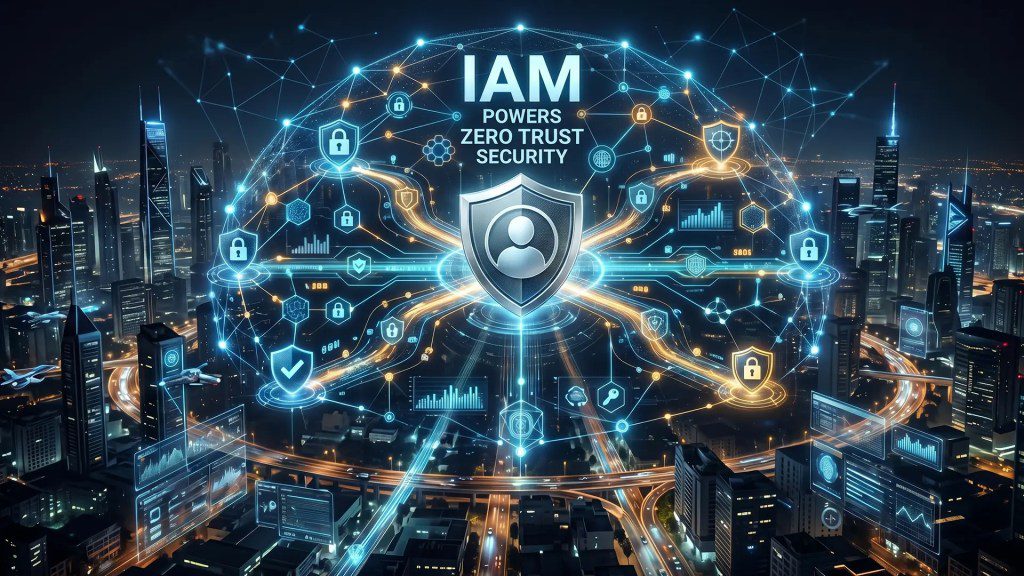
For decades, cybersecurity strategies were built around a simple assumption: if organizations could protect the network perimeter, they could protect their assets. Firewalls, VPNs, and network controls became the first line of defense against external threats. But today’s digital landscape looks very different.
Employees work from anywhere. Applications run across multiple clouds. Third-party vendors access critical systems. Artificial intelligence tools are rapidly expanding access points. In this environment, the traditional security perimeter has effectively disappeared.
This shift has given rise to Zero Trust Architecture, a security model based on the principle of “never trust, always verify.” At the center of this approach lies a critical capability: Identity and Access Management (IAM).
As organizations rethink cybersecurity investments, many Chief Information Security Officers (CISOs) are shifting budgets away from perimeter-based defenses and toward identity-centric security. The reason is simple: identity has become the new perimeter.
What Is Identity and Access Management (IAM)?
Identity and Access Management (IAM) refers to the technologies, policies, and processes that ensure the right individuals have appropriate access to the right resources at the right time.
An effective IAM framework helps organizations:
- Verify user identities
- Control access privileges
- Enforce authentication requirements
- Monitor access activities
- Reduce insider and external threats
- Maintain regulatory compliance
IAM is no longer just an IT function. It has become a foundational pillar of enterprise cybersecurity and digital transformation strategies.
In a Zero Trust environment, every user, device, application, and workload must continuously prove its identity before access is granted. IAM provides the mechanisms that make this possible.
Why Traditional Security Perimeters Are No Longer Enough
The enterprise network was once a clearly defined boundary. Users worked within office walls, applications were hosted in company-owned data centers, and security teams focused on defending a centralized environment.
Today, organizations operate in a highly distributed ecosystem:
- Hybrid workforces access resources remotely.
- Cloud-native applications span multiple environments.
- IoT and connected devices introduce new attack surfaces.
- Partners and contractors require privileged access.
- AI-powered systems consume and generate sensitive data.
Cybercriminals have adapted to this reality. Instead of attacking infrastructure directly, attackers increasingly target identities.
Stolen credentials, compromised accounts, session hijacking, and privilege escalation attacks have become some of the most common methods used to gain unauthorized access.
Why Identity Is the New Perimeter
In a Zero Trust model, trust is never assumed based on network location. Instead, trust is established through continuous identity verification.
Every access request must answer several questions:
- Who is requesting access?
- What device are they using?
- What resource are they attempting to access?
- Is their behavior consistent with normal activity?
- Should access be granted, limited, or denied?
The identity itself becomes the primary security control.
This approach reflects a fundamental shift in cybersecurity thinking. Organizations are moving from securing networks to securing identities.
As a result, modern IAM security platforms are evolving beyond authentication and authorization to include:
- Adaptive access controls
- Behavioral analytics
- Risk-based authentication
- Continuous monitoring
- Privileged access governance
- Identity threat detection and response (ITDR)
These capabilities enable organizations to make real-time access decisions based on risk rather than static rules.
The Role of IAM in Zero Trust Security
Identity and Access Management serves as the operational engine behind Zero Trust Architecture.
Without robust IAM capabilities, Zero Trust remains largely theoretical.
Read More: The Modern Data Engineering Stack in 2026: Architecture, Tools, and Strategy for AI-Driven Enterprises
Strong Authentication
Multi-factor authentication (MFA) has become a foundational requirement for Zero Trust identity strategies.
By requiring additional verification factors beyond passwords, organizations significantly reduce the risk of credential-based attacks.
Modern authentication methods include:
- Biometric verification
- Security keys
- Mobile authentication apps
- Passwordless authentication
Passwordless approaches are gaining momentum as organizations seek to improve both security and user experience.
Least Privilege Access
One of the core principles of Zero Trust is granting users only the minimum level of access necessary to perform their responsibilities.
IAM solutions help organizations enforce least-privilege policies through:
- Role-based access control (RBAC)
- Attribute-based access control (ABAC)
- Just-in-time access provisioning
This reduces the potential impact of compromised accounts and insider threats.
Continuous Verification
Traditional authentication often occurs only at login.
Zero Trust identity models require continuous validation throughout a user’s session.
IAM systems can analyze:
- User behavior
- Device health
- Geographic location
- Access patterns
- Risk indicators
If suspicious activity is detected, additional verification can be triggered automatically.
Privileged Access Management
Privileged accounts remain among the most attractive targets for attackers.
Modern IAM ecosystems increasingly integrate Privileged Access Management (PAM) capabilities to secure administrative accounts and sensitive credentials.
Organizations implementing Zero Trust security often prioritize PAM investments because privileged account compromise can lead to widespread breaches.
Why CISOs Are Prioritizing Identity Security Investments
Cybersecurity budgets are undergoing a noticeable transformation.
Historically, network security dominated spending priorities. Firewalls, intrusion prevention systems, and perimeter defenses received significant investment.
Today, security leaders recognize that attackers often bypass these controls by exploiting identities instead.
Several factors are driving this shift:
Read more: Building Scalable Data Pipelines for Enterprise Growth
Identity-Based Attacks Are Increasing
Credential theft remains one of the most common entry points for cyberattacks.
Attackers use phishing campaigns, social engineering techniques, and malware to gain access to legitimate credentials.
Once authenticated, they can move through systems while appearing as trusted users.
Cloud Adoption Demands New Controls
Cloud environments require organizations to manage access across multiple platforms and applications.
Traditional network boundaries no longer provide sufficient protection.
IAM solutions provide centralized visibility and control over access across hybrid and multi-cloud ecosystems.
Compliance Requirements Are Expanding
Regulations increasingly emphasize identity governance and access controls.
Organizations must demonstrate:
- User accountability
- Access auditing
- Privilege management
- Security policy enforcement
IAM platforms help support these compliance objectives while reducing operational complexity.
AI Is Creating New Security Challenges
Generative AI and autonomous systems are introducing machine identities into enterprise environments.
Organizations now manage not only human users but also:
- AI agents
- APIs
- Service accounts
- Automated workflows
Securing these identities requires advanced IAM capabilities and stronger governance frameworks.
Emerging Trends in Identity and Access Management
The future of IAM security is being shaped by several important developments.
Identity Threat Detection and Response (ITDR)
Organizations are increasingly adopting ITDR solutions to detect identity-based attacks before they escalate.
These platforms monitor authentication activities and identify suspicious behaviors in real time.
Passwordless Authentication
Many enterprises are moving away from traditional passwords altogether.
Passwordless technologies improve user experience while reducing credential-related risks.
AI-Powered Access Decisions
Artificial intelligence is helping organizations make smarter access decisions by analyzing behavioral patterns and risk signals continuously.
Unified Identity Platforms
Enterprises are seeking integrated solutions that combine:
- IAM
- PAM
- Governance
- Authentication
- Identity analytics
This convergence simplifies security operations while improving visibility.
The Road Ahead
The concept of a trusted network perimeter is rapidly becoming obsolete. As enterprises embrace cloud computing, hybrid work, AI-driven operations, and digital ecosystems, identity has emerged as the most critical security control.
Identity and Access Management now sits at the heart of Zero Trust Architecture, enabling organizations to verify every user, validate every device, and monitor every access request continuously.
For CISOs, the message is becoming increasingly clear: cybersecurity resilience depends less on where users connect from and more on who they are, what they can access, and how their behavior aligns with organizational risk policies.
In the era of Zero Trust security, identity is no longer just part of the security strategy, it is the security strategy.
FAQs
- What is Identity and Access Management (IAM)?
Identity and Access Management (IAM) is a cybersecurity framework that manages user identities and controls access to applications, systems, and data based on defined policies. - Why is IAM important for Zero Trust Security?
IAM enables Zero Trust by continuously verifying users and devices before granting access, ensuring that trust is never assumed. - How does IAM improve enterprise security?
IAM reduces the risk of unauthorized access through authentication, access controls, privilege management, and continuous monitoring. - What is meant by “identity is the new perimeter”?
As traditional network boundaries disappear, user identities have become the primary control point for securing access to enterprise resources. - What are the core components of an IAM solution?
Key IAM components include authentication, authorization, single sign-on (SSO), multi-factor authentication (MFA), identity governance, and privileged access management (PAM).