
ITTech Pulse Exclusive Interview with Debbie Gordon Founder/CEO at Cloud Range
Stay updated with us
Sign up for our newsletter
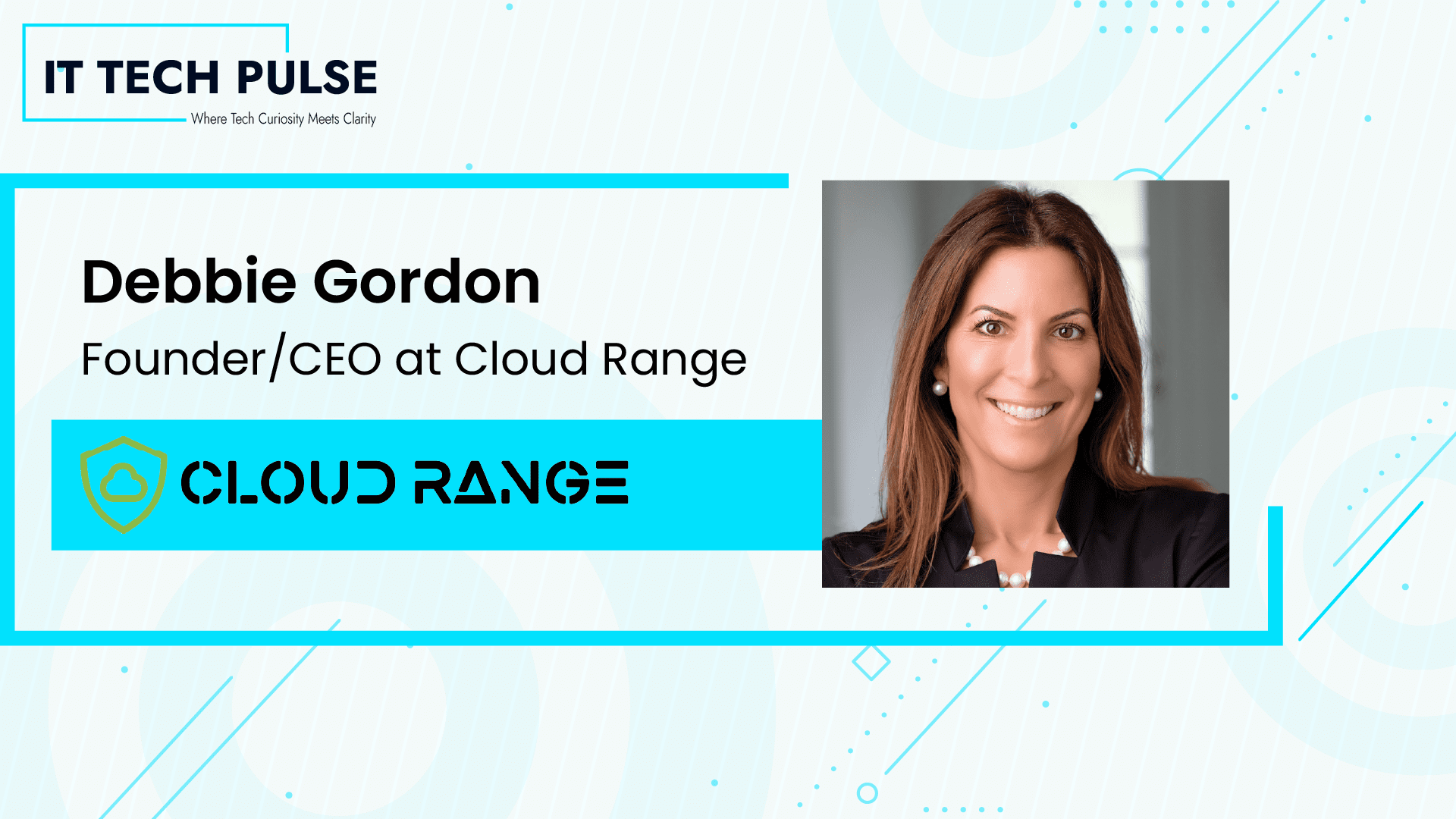
Debbie Gordon, CEO of Cloud Range, discusses AI validation, cyber range innovation, and enabling safe testing of AI systems before real-world deployment.
Excited about Cloud Range’s new AI Validation Range – what key problem does it solve for IT leaders testing AI models safely before production?
Until the release of Cloud Range’s AI Validation Range, organizations have not had a reliable way to validate how AI systems behave before deployment – especially during cyber incidents. Too often, organizations either take risks by testing directly in production or skip thorough testing altogether. Cloud Range’s AI Validation Range changes that by giving leaders a dedicated range environment, sometimes called a sandbox, where teams can safely test and validate AI behavior before deployment.
This includes running large language models (LLMs) and AI agents through a variety of Cloud Range’s simulated attacks and adversarial scenarios to stress-test agent behavior, analyze failure points, and validate recovery mechanisms. Adversarial inputs can be safely introduced to understand how the AI systems respond to threats like data poisoning, prompt injection, or hallucinations.
You can also compare the performance of human defenders and AI agents‘ side by side under ral-world pressure, measuring not just speed, but also accuracy, decision quality, and false positive rates. This kind of rigorous, hands-on testing, in combination with Cloud Range’s metrics and reporting, gives IT leaders operational confidence that their AI systems are reliable, secure, and validated – before they ever touch production.
And it’s not just for IT leaders. Cloud Range’s AI Validation Range supports a broad range of users: from AI researchers and AI-driven software companies developing or fine-tuning LLMs to organizations deploying private LLMs and managed security service providers (MSSPs) leveraging AI agents for cybersecurity services. It’s also ideal for any organization designing or deploying its own AI agents, especially those focused on cybersecurity. For all of these groups, having a controlled, flexible environment to safely test, train, experiment, and validate the reliability of their AI solutions is a gamechanger.
Read More: ITTech Pulse Exclusive Interview with Mark Wojtasiak is SVP of Product Research and Strategy at Vectra AI
IT decision-makers often search “AI cyber testing platforms”- how does your range stand out in adversarial simulations for agentic AI?
What sets our solution apart is the depth and realism of our adversarial simulations that customers use to test their AI agents. Most tools out there focus on isolated techniques, for instance, only the initial access point. Because Cloud Range’s AI Validation Range incorporates our entire library of live-fire simulations, AI systems (and humans) experience entire attack chains from start to finish, including all the pivots, alerts, and live network traffic you’d see in the real world.
The range also includes a full IT and OT network with a suite of licensed IT, OT/ICS, and cloud security tools, and it can be tailored to emulate customers’ environments. This allows AI agents to operate within workflows, processes, and tool stacks within real SOC environments.
The result is that organizations have a much more comprehensive and SAFE way to test and train their AI models and agents, observing how they perform during realistic cyber incidents rather than isolated test cases, so they’re prepared for the full range of threats they might face.
Readers want secure AI deployment insights; can you share a real example of training SOC agents without risking live data?
Absolutely. We’ve worked with leading AI companies to help them test and train their AI models and agents in our range. There is no risk to live data because it is a safe and secure contained environment.
All testing and training on the AI Validation Range utilizes Cloud Range’s datasets and tools, so there’s no risk to a customer’s live systems or data. This setup even allows for things like adversarial inputs or manipulated data to observe how the AI responds to unexpected conditions or decision-making errors.
And once initial testing is done, the models can be updated and retested repeatedly before they’re put back into production, allowing teams to continually refine performance and validate improvements in a controlled environment. This ongoing process gives organizations greater confidence that their AI deployment is constantly secure.
Read More: ITTech Pulse Exclusive Interview with Eric Schwake, CISSP, Director of Cybersecurity Strategy at Salt Security
What feedback have you heard from early users on validating AI reliability versus human defenders in cyber scenarios?
One of the unique advantages of Cloud Range’s AI Validation Range is that it allows organizations to directly compare the performance of human defenders to AI agents in the same simulated scenarios.
We’re hearing that while AI can detect and alert faster, humans are generally more accurate and better at nuanced decision-making (for now at least!). By running humans and agents’ side by side in the range, teams can measure not just speed, but also accuracy, decision quality, proper escalation, and the rate of false positives – giving a much clearer picture of where AI excels and where human oversight is still essential.
These comparisons help organizations determine where automation adds the most value and where maintaining a “human in the loop” is critical for decision validation and oversight.
Looking ahead, what 2026 trends in AI-driven threats worry you most, like faster exploits or poisoned models?
We’re seeing AI accelerate and scale existing attack techniques, especially in areas like supply chain attacks. AI can quickly find and exploit vulnerabilities across interconnected systems, making attacks more efficient and widespread.
It’s not so much that AI is inventing new types of attacks, but it’s definitely making traditional tactics, techniques, and procedures (TTPs) much more efficient, scalable, and powerful. At the same time, attackers are exploring ways to manipulate AI systems themselves, using techniques such as prompt injection, adversarial inputs, and attempts to influence automated decision-making.
For 2026, how will tools like AI Validation Range help IT teams predict and counter AI-powered ransomware attacks?
Cloud Range’s AI Validation Range gives IT teams a safe environment to practice their security response, test detections, and validate security controls against ransomware scenarios.
Both human and AI agents can be evaluated for their effectiveness in detecting and responding to these attacks. Teams can observe how AI systems prioritize alerts, recommend actions, and interact with human responders during an active attack scenario.
While the underlying mechanics of ransomware remain consistent, AI is accelerating the efficiency and scale at which these attacks can be carried out. This makes it even more important for organizations to rigorously test their defenses and response strategies in advance, ensuring they’re prepared for the increased speed and sophistication that AI brings to the table.
Decision-makers search “agentic AI security 2026” – what adoption shifts do you foresee for cyber ranges in enterprises?
We are already seeing a big shift toward enterprises adopting more structured processes for rolling out AI workflows and agents.
That means they are beginning to clearly define use cases, set up access controls, and ensure proper monitoring is in place. AI agents are increasingly functioning like digital operators inside enterprise systems, which means they need the same level of oversight, logging, and validation that human operators require.
The step that’s often missing right now is pre-production validation, and that’s why Cloud Range’s AI Validation Range is an integral element in proper AI deployment. Organizations are clearly increasing the adoption of these environments to test their AI tools and protocols before anything goes live.
Finally, any tips for our readers on starting AI validation today to stay ahead in the AI-cyber arms race?
When thinking about how to get started with AI validation, I always tell people to be really specific about their implementation strategy and testing plan.
First, define exactly how you’ll measure the success of your AI deployment. Don’t just look at speed, but also at accuracy and the rate of false positives. Security leaders should be asking whether AI actually improves detection quality and response outcomes under realistic attack conditions.
It’s crucial to have a dedicated space, like the AI Validation Range, where you can safely test and validate everything before it goes live. If you can’t measure it, don’t deploy it. That’s the best way to stay ahead in this rapidly evolving landscape.
Thank you, Debbie, for taking the time to share your insights with us.
Write to us [wasim.a@demandmediaagency.com] to learn more about our exclusive editorial packages and programmes.
Debbie Gordon is the founder and CEO of Cloud Range and a globally recognized entrepreneur focused on strengthening cybersecurity readiness at the organizational level. Through her work, she advocates for helping organizations move beyond theoretical security strategies to ensure their people, processes, and technologies can perform effectively under real attack conditions.
Debbie began her career over 30 years ago in the technical education and certification space and has since built and sold several companies in eCommerce, IT asset management, and training. Her work today focuses on advancing practical approaches to cyber readiness, including live-fire simulations that allow organizations to evaluate performance and improve response capabilities before real incidents occur.
A frequent speaker on cybersecurity readiness, team effectiveness, and simulation methodologies at conferences and seminars all around the world, Debbie has also been featured on numerous podcasts, authored articles on cyber preparedness and organizational performance, and has been quoted in major publications including Fox News, Wall Street Journal, and Forbes.
Cloud Range is a pioneer in cyber range platforms that help organizations test, validate, and strengthen their cyber capability before real incidents occur. Its full-service, cloud-based cyber range provides realistic IT, OT/ICS, and cloud environments where organizations can safely evaluate how their people, processes, technologies, and AI systems perform under real-world cyberattack conditions.
Cloud Range’s cyber range platform enables organizations to validate the performance of both human operators and AI systems through live-fire simulations that mirror real-world attacks. Used by enterprise SOC and incident response teams, managed security service providers (MSSPs), governments, higher education institutions, utilities, and other critical infrastructure organizations, the platform enables leaders to measure team performance, assess candidates, onboard new hires, validate security tools and processes, and test and train AI models and agents before deployment.
Cloud Range has received numerous industry awards, including the CISO Choice Award for security education and training, the Top InfoSec Innovator Award for Cutting Edge Cyber Defense Training, the Fortress Cyber Security Award for Best Cybersecurity Training, and the ASTORS Homeland Security Award for Best Cyber Defense Team Training.