IT Tech Pulse Exclusive Interview with Michael Bradshaw Sr. VP, Global Practice Leader for Applications, Data and AI at Kyndryl
Stay updated with us
Sign up for our newsletter
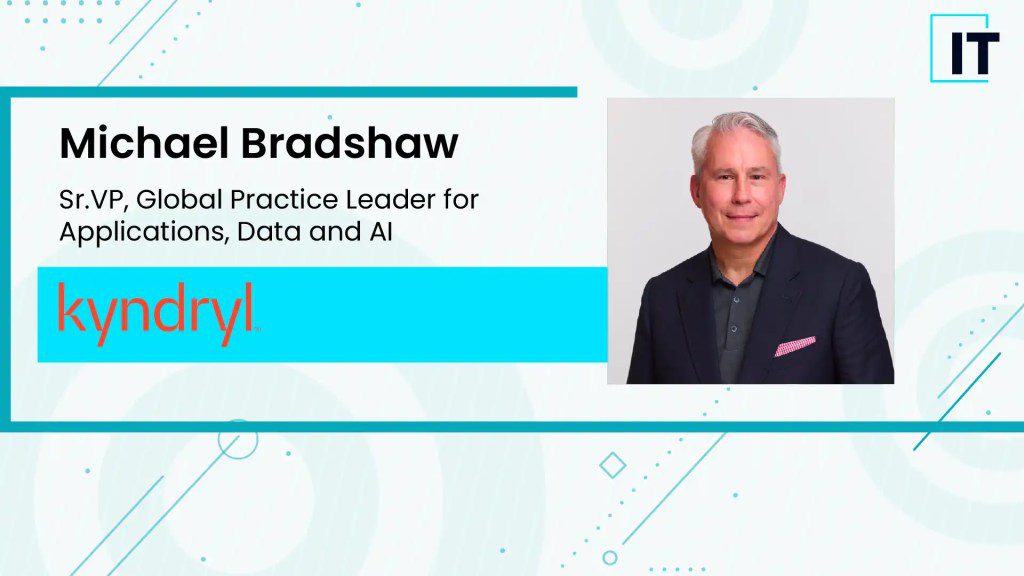
Michael Bradshaw Sr. VP, Global Practice Leader for Applications, Data and AI at Kyndryl, discusses how Clean Core principles and agentic AI simplify SAP modernization.
As Kyndryl’s CIO, you led the company’s IBM independence sprint, decoupling legacy systems within 24 months. What technical lessons from that project directly shaped your approach to SAP modernization today?
When we spun in 2021, we had 24 months to fully stand up Kyndryl as an independent technology organization. This required disentangling deeply integrated legacy systems, consolidating thousands of workloads, and rebuilding our enterprise architecture with a cloud-first mindset – all in an extremely accelerated timeline and without disrupting business operations.
One of the most important lessons we learned was that modernization begins with ruthless clarity about what truly adds business value – and what doesn’t. We couldn’t afford to carry forward redundant applications, overlapping functionality or tightly coupled architectures that limited agility. Instead, we designed a fit-for-purpose technology estate that supported our evolving business model and expanding alliance ecosystem and embraced a platform strategy that provided us with a strong, agile digital foundation and enabled us to meet our transformation timeline.
That experience from start to finish reinforced the importance of simplification, modularity and disciplined governance. Today, when we approach SAP modernization, we apply the same philosophy: rationalize first, decouple intelligently and design for adaptability from the outset, rather than attempting to optimize complexity after the fact. This enables customers to build a digital foundation that supports their business of today and tomorrow.
Read More: ITTech Pulse Exclusive Interview with Dean Valentine, CEO and Co-founder of ZeroPath
During Kyndryl’s decoupling, you closed on-premises data centers, consolidated 1,500 applications into a few hundred, and dismantled silos. How are those exact architectural disciplines now embedded in your Clean Field methodology for customer SAP migrations?
In our decoupling, consolidation and simplification were not optional – they were essential to meet our required timeline and build a sustainable foundation for a new future enterprise. What we know is that technical debt compounds quickly if you let silos get out of control. Meaningful and successful transformation requires the intentional elimination of redundancy, and that’s where our Clean Field approach makes a difference. By applying agentic AI, you can more quickly achieve a clean core migration that simplifies and streamlines SAP ERP upgrades, rather than simply moving a legacy system – and its technical debt, performance and stability issues – to a new structure.
By bringing this same discipline to SAP migrations, organizations can evaluate what should – or should not – be retained, modernized or retired. This applies to the various customizations made over the years, as well as the data that has collected within the systems over that time. By focusing on achieving a clean core migration, we help our customers reduce unnecessary customizations and adopt standardized processes, so their SAP S/4HANA environments are adaptable and aligned to long-term business goals – with only the data needed within their new system of record.
Most SAP S/4HANA projects get stuck on custom code remediation. Z-objects, WRICEF interfaces, legacy workflows. Why did Kyndryl identify this as the core technical problem that agentic AI could actually solve?
Over 60% of SAP customers are still on ERP Central Component (ECC) with an ambiguous path to SAP S/4HANA. Their ECC systems carry years of custom code, fragmented data and inconsistent processes. These organizations have environments that are complex, fragile and difficult to change. But the cost of not transforming is too high for enterprises trying to future-proof their organizations and drive innovation. These organizations need a way to migrate that reduces the time, complexity and cost of current approaches. Beyond having to decide whether to move to SAP S4/HANA now or later, leaders must determine when to involve business teams, what to do with massive amounts of custom code and how to preserve data integrity. Addressing even one of these issues makes the process less daunting.
Custom code remediation is often the most common technical bottleneck that causes SAP S/4HANA programs to stall. Decades of Z‑objects, WRICEF interfaces, and hard‑coded workflows embed critical business logic, creating enormous volumes of repetitive, rules‑driven work that traditional migration approaches can’t handle efficiently. That made it an ideal area to apply agentic AI, not to redesign the business, but to take on the heavy technical lifting. By employing AI agents to systematically analyze, rationalize, refactor and rebuild custom code within SAP Clean Core standards, Kyndryl removed the technical drag that often slows migrations, while keeping our experts firmly in control of business decisions.
Greenfield rips and replaces. Brownfield drags legacy forward. Clean Field selectively modernizes. What’s the technical architecture difference, and why does it reduce both risk AND timeline compared to traditional approaches?
The fundamental difference lies in architectural intent. Greenfield approaches rebuild everything from scratch, which can be transformative for businesses burdened by legacy SAP workflows and custom code, but the whole redesign requires reimplementing years of embedded business logic, driving longer timelines and more risk for business disruption.
Brownfield approaches sit at the opposite extreme, preserving nearly every legacy artifact, including the technical debt that created modernization pressure in the first place.
Clean Field blends the best of both by starting with a full fit-to-standard analysis, identifying which existing capabilities should be moved, and then selectively customizing and modernizing the code that cannot. It uses agentic AI to assess, document, simplify, build and test at scale, helping organizations more easily determine what should be kept, redesigned or retired, rather than creating it all from scratch or simply moving everything to a new platform. By enforcing Clean Core standards while reducing the volume of legacy code carried forward, our Clean Field approach produces a more adaptive system. One that lowers risk by preserving critical business logic and accelerates timelines by removing the largest technical barrier for SAP S/4HANA migrations.
Read More: ITTech Pulse Exclusive Interview with Nicholas Janouskovec Global Cybersecurity Business Development Manager at Emerson
Enterprises are nervous about AI making consequential decisions in their ERP transformations. How does Kyndryl’s approach keep humans in the loop while AI accelerates the actual remediation work at scale?
As with any transformation initiative involving AI, Kyndryl is deliberate about where and how the AI is applied in ERP transformations. Our Clean Field approach is designed so AI agents operate within defined boundaries and serve as an accelerator, not an autonomous decision maker. The AI agents are used to analyze code, identify patterns and recommend actions, but human expertise and oversight is always applied to final decisions, especially around business logic, process changes and architectural design.
Our recently announced policy as code capability for the Kyndryl Agentic AI Framework is how we govern agentic workflows, so agents only execute deterministic actions permitted and enforced by pre-defined policies, reducing operational and regulatory risk. This essential component alleviates trust, control and compliance concerns, especially for customers in highly complex, regulated environments.
The goal is not to replace human expertise, but to amplify it, and by collaborating with AI agents, experts can move faster without compromising risk management or compliance standards.
With SAP ECC mainstream support ending in December 2027 and only expensive extended support to 2030, what’s the realistic timeline for a mid-to-large enterprise to complete SAP→S/4HANA migration responsibly?
Most mid-to-large enterprises require a longer realistic SAP S/4HANA migration timeline that typically requires between 18 to 48 months – sometimes longer, depending on a company’s level of complexity, geographic footprint and regulatory requirements and the approach chosen. This timeline includes discovery and planning to evaluate things like infrastructure requirements and custom code impact, data cleansing and migration, exporting data from existing databases into the HANA database, testing and validation, organizational change management and more. With mainstream support ending in December 2027, organizations that delay their start risk compressing these phases into an unrealistic window.
Our Clean Field approach accelerates the most time-sensitive aspects of migration by applying agentic AI to reduce manual, time-intensive tasks and limit rework caused by human error – often compressing timelines from months to days.
However, even with the speed and efficiency Kyndryl’s Clean Field approach can deliver, businesses shouldn’t postpone their transformations to make sure they’re completed with stability rather than deadline pressure.
If SAP S/4HANA becomes an intelligent orchestration engine where agentic AI continuously optimizes processes, identifies inefficiencies in real-time, and recommends automations, what must change about how IT teams run SAP operations versus legacy ERP management?
IT teams will need to move away from traditional, manual system administration and adopt a more strategic operating model focused on governance, orchestration and continuous optimization. In legacy ERP environments, teams spent most of their time reacting to incidents, managing updates and maintaining systems. In an AI-enabled SAP S/4HANA environment, the focus shifts from being reactive to being proactive. This will require designing guardrails, managing data quality and overseeing how automation and AI recommendations are applied.
The KPIs around success will also shift, no longer being measured by system uptime alone, but instead, the sustained process improvement, faster time to value and the ability to continuously modernize your ERP landscape without business disruption.
Thank you, Michael, for taking the time to share your insights with us.
Write to us [wasim.a@demandmediaagency.com] to learn more about our exclusive editorial packages and programmes.
Michael Bradshaw is the Global Practice Leader for Applications, Data and AI at Kyndryl, where he helps enterprises scale AI beyond isolated pilots into orchestrated, mission-critical execution. He’s a regular voice on AI-native transformation, speaking at industry events like WIRED’s “Rethink AI” series”
We have the world’s best talent that design, run, and manage the most advanced and reliable technology infrastructure each day. Together, we think holistically about the health of these vital technology ecosystems. We are a focused, independent company that builds on our foundation of excellence by creating systems in new ways. Bringing in the right partners, investing in our business, and working side-by-side with our customers to unlock potential. We’re raising the bar. Our experience speaks for itself: We have tens of thousands of highly skilled employees around the world serving most of the Fortune 100 companies. But our purpose is what drives us: Advancing the vital systems that power human progress. Because when a digital ecosystem is healthy, it can more readily adapt and support continuous growth and that opens up a world of possibility for everyone.