

ITTech Pulse Exclusive Interview with Stanley R. Hughey, Chief Technology Officer at iNet
Stay updated with us
Sign up for our newsletter
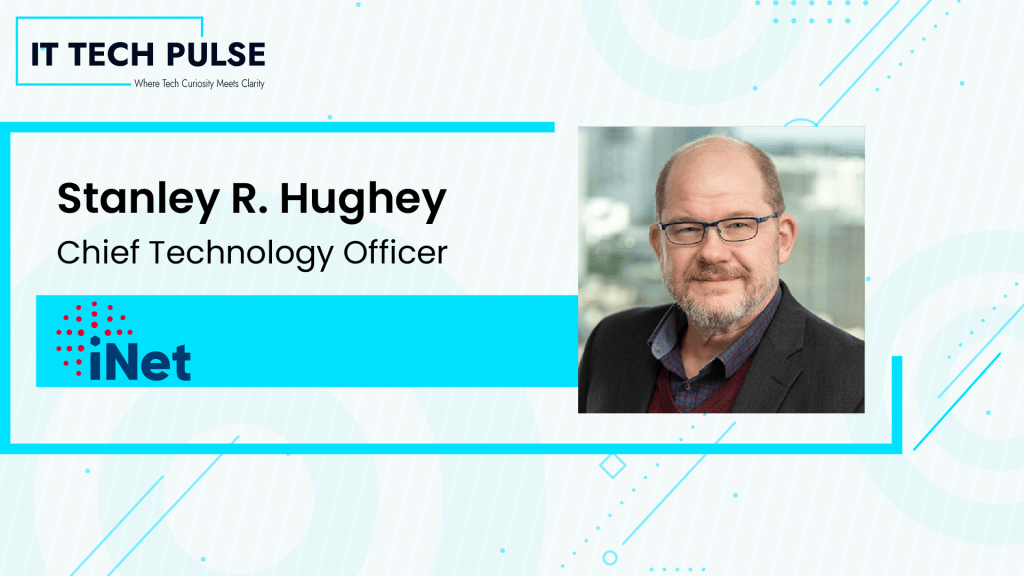
Stanley R. Hughey, CTO of iNet, shares how hybrid connectivity and edge intelligence help enterprises scale Industry 4.0 initiatives in remote locations.
iNet built one of the largest private LTE footprints for remote industries. What early market gap convinced you this model would outperform traditional connectivity options in harsh operating environments?
In the early days we saw a glaring gap: critical operations in remote, harsh locations were stuck with “good enough” communications – or sometimes no real broadband at all. Traditional carriers simply weren’t present in oilfields and far-flung industrial sites, and the ad-hoc solutions (patchy satellite links, point-to-point radios, Wi-Fi hotspots) kept failing where reliability was most needed. Coming from an oil & gas background, we knew those operations needed carrier-grade connectivity built for the field, not the city. So we set out to create a private LTE network on licensed spectrum that would cover the oil patch and beyond – effectively bringing enterprise-class, 99.9%+ reliable data service to the middle of nowhere. We didn’t design our network for consumer handsets; we engineered it for industrial data flows – pump monitors, SCADA control, video feeds – the kind of traffic that remote sites require to run safely and efficiently. Our bet was that a purpose-built wireless network, hardened for extreme environments, would far outperform the patchwork of VSAT and unlicensed gear that operators had been trying to use.
That bet paid off. By owning a wide-area LTE footprint (now over 130,000 square miles across multiple shale basins) and dedicating it solely to remote industrial users, we gave customers something they never had before: a ready-to-go, high-performance network in places previously off the grid. Instead of each company struggling to cobble together its own system, they could plug into our private network and get the throughput and uptime previously only seen in big-city fiber networks. We essentially connected what others couldn’t. The early gap was clear – remote industries had been underserved and left to make do with fragile comms – and we proved that a robust private LTE model could fill it. We demonstrated that even in the middle of a West Texas oilfield or a far-off mining site, you can have connectivity that’s as solid as the network in a downtown high-rise. That was a gamechanger for our customers, opening the door for all their Industry 4.0 ambitions at the edge.
Your network serves sectors where uptime directly impacts revenue and safety. How does iNet engineer reliability standards that enterprise leaders can confidently build automation strategies around?
Reliability is something we engineer deliberately, end-to-end, because in our world lives and millions of dollars can hinge on the network. From day one we designed iNet’s infrastructure to meet or exceed “four nines” availability – the kind of 99.99% uptime you usually only get from fiber circuits. Achieving that in remote wireless environments meant rethinking everything. We use licensed spectrum and built our towers and backhaul with plenty of redundancy, so there’s no single point of failure. In most deployments, we deliver a hybrid connectivity architecture – for example, combining private LTE with a satellite or fiber backup – so if one link goes down, another automatically takes over. Our Continuum™ platform is multi-transport by design, meaning it can seamlessly hand off between 4G/5G, LEO satellites, and other networks without users noticing a hiccup. We also harden our field equipment to withstand extreme weather and power challenges, and we invest heavily in RF planning to ensure coverage overlaps in critical areas. Essentially, we build the network as if lives depend on it – because in many cases they do. That allows our customers to trust it for automation: they know the connectivity will be there when the drill needs to send a shutdown command or when an AI camera has to flag a safety alert in real time.
Another pillar of reliability is active management and expertise. We don’t just drop off equipment and hope for the best; iNet provides a fully managed service with a 24/7 Network Operations Center watching every link and device on our network. We’ve got industrial networking specialists who understand the demands of SCADA, real-time video, and critical voice services, and they are constantly optimizing performance and preemptively addressing issues. For example, if there’s a spike in latency or an interference source, our team (and increasingly our AI tools) will detect it and mitigate it before it impacts operations. We also architect our SLAs very tightly around uptime and latency, and we stand behind them. In fact, in sectors like energy we often commit to uptime standards (99.9% and above) that give enterprises the confidence to automate. And because we focus on critical infrastructure environments, we appreciate that downtime is more than an inconvenience – it hits revenue, productivity, even safety. So, we bring an engineering mentality that’s about preventing failures and ensuring continuity. The bottom line is, we make reliability a non-negotiable design goal. That frees our customers to pursue advanced automation and digital initiatives – things like remote robotics, real-time analytics, autonomous equipment – knowing the network foundation is rock-solid and won’t be the weak link in their strategy.
From oilfields to broader industrial markets, iNet’s evolution is notable. Which adjacent industries now represent the biggest opportunity for private wireless transformation and why?
We’re seeing tremendous interest beyond oil & gas in sectors that have very similar connectivity pain points. Utilities and power infrastructure are high on the list. Electric grids, for example, have thousands of remote substations and renewable generation sites (solar farms, wind turbines) that need secure, low-latency links for monitoring and control. Many of those sites are in rural or hard-to-reach areas where traditional fiber or public cellular isn’t reliable. A private wireless network gives utilities a dedicated, high-reliability channel for their SCADA data and grid automation – no more dependence on patchy carrier signals. We can cover their remote assets with private LTE/5G and layer in LEO satellite backup for redundancy, so even during a storm or disaster they don’t lose communication. As utilities modernize the grid and add more IoT sensors and automated controls, this kind of managed, mission-critical network is becoming essential. We’ve already expanded into supporting power companies with these challenges, and the demand there is only growing – it’s a natural extension of what we pioneered in oilfields, just applied to the smart grid era.
Renewable energy operations – like large wind farms, solar arrays, and battery storage sites – are another big opportunity. They often exist at the edge of the grid with minimal connectivity, yet operators need real-time data to optimize power output and perform predictive maintenance. We’re finding that a private wireless solution can dramatically improve how these sites are run. For instance, a wind farm spread over miles of terrain can be equipped with private LTE for turbine telemetry, drone inspections, and even augmented reality for tech crews. Then that network can tie back into the utility or ISO via satellite or fiber. In short, we enable renewables operators to treat remote energy sites as fully connected endpoints, which is crucial as renewable portfolios scale up.
We also see mining and other heavy industries embracing private wireless. Mines are essentially like oilfields in terms of connectivity needs – they’re remote, sprawling, and full of machinery that’s getting smarter every year. Many mining companies are deploying autonomous haul trucks and remote-operated drilling rigs, which require extremely reliable, low-latency communication across a pit or underground complex. Wi-Fi struggles with that, and running fiber everywhere is impractical, so private LTE/5G is a perfect fit. We’ve started to support mining operations with networks that can withstand the dust, vibration, and movement inherent in those sites, while providing robust coverage across mine pits and tunnels. It’s about bringing the same “always-on” ethos so miners can trust their network for everything from vehicle telematics to real-time video from excavators.
Lastly, maritime and offshore sectors present a huge growth area. Think of vessels, cargo fleets, and offshore platforms – they all need better connectivity. Historically they’ve been limited to high-latency satcom or very basic line-of-sight radio. Now, with new LEO satellite constellations and our hybrid networking approach, we can offer ships and offshore installations a seamless network that blends satellite, cellular (when near coast), and intelligent routing. For example, we can equip an offshore service vessel with a managed system that uses 4G/5G when within range of shore, and switches to high-throughput LEO satellite as it heads out to sea – all secured and optimized via our platform. Maritime operators are eager for this because so much of their operation (and crew welfare) is going digital. Reliable broadband at sea improves everything from navigation updates to engine telemetry to crew communications. We’ve already been working in offshore energy, so expanding to general maritime was a logical step.
In all of these adjacent industries – utilities, renewables, mining, maritime – the common thread is critical operations in remote or distributed locations, where legacy networks fall short. They stand to gain the same transformation that oilfields did by adopting private wireless: higher uptime, more data visibility, and the ability to integrate advanced applications (AI, edge computing, automation) because the connectivity can support it. And importantly, we’re helping these sectors not just with wireless access, but with a unified, hybrid approach from day one. That means whether it’s LTE, 5G, satellite, or fiber, all of it comes together under one managed service so they get the best of every technology without the complexity. I genuinely believe these industries are just beginning their private wireless journeys – and by leveraging our experience, they can leapfrog to a more intelligent, resilient networking model much faster. It’s an exciting evolution, and it mirrors exactly what we set out to do: connect what others can’t, in all the places that matter.
Many companies discuss Industry 4.0, but connectivity remains the blocker. How do you help customers turn AI, IoT, and real-time data ambitions into operational reality?
We tackle that connectivity barrier head-on by providing the reliable, high-performance network foundation that those Industry 4.0 technologies need. In remote or rugged sites where traditional networks fall short, iNet delivers enterprise-grade connectivity so data can flow freely from IoT devices and AI systems in the field. In practice, that means we’ve built out dedicated broadband wireless networks, deployed Starlink LEO services and integrated fiber optics and wireless services from major 4G/5G commercial providers with the level of reliability and throughput you’d expect in a corporate data center. By eliminating dead zones and bottlenecks, we ensure our customers’ sensors, machines, and analytics platforms stay connected in real time.
Importantly, we make the network smart as well as strong. It’s not just raw bandwidth – it’s an intelligent platform. We integrate edge computing and AI-driven orchestration so the network can adapt on the fly to changing conditions. For instance, through our partnership with Quvia, we’ve added AI Quality-of-Experience management that automatically optimizes data flows for critical applications, even if a link degrades. This means if you’re running a machine-vision algorithm on a remote drill site, the network will dynamically prioritize that traffic to maintain low latency and high quality. By making connectivity both available everywhere and intelligently managed, we turn our customers’ AI, IoT, and real-time data ambitions into day-to-day operational reality. In short, we ensure that once you have the great ideas and devices of Industry 4.0, the network will not be the limiting factor – it becomes the enabler.
With 4G, 5G, satellite integration, and edge technologies advancing fast, how should infrastructure leaders prioritize investments without overcomplicating their long-term connectivity roadmap?
The key is to stay outcome-focused and architect for flexibility. Rather than betting on one “silver bullet” technology, we advise building a unified connectivity fabric that can incorporate multiple access technologies as needed. 4G LTE, 5G, LEO satellite, fiber, edge compute – each has strengths for certain scenarios. Instead of deploying them in piecemeal fashion (which often leads to a tangled mess of systems), you want an integrated approach where all these options plug into one managed network. That’s exactly how we design iNet’s platform: as a multi-transport, hybrid network that blends terrestrial and LEO satellite links seamlessly. This way, you can prioritize reliability and coverage for your use case now (say, using private LTE for a mine site), while remaining ready to slot in new capabilities (like a Starlink LEO satellite or 5G upgrade) when they prove valuable – without a complete overhaul.
In practical terms, I tell infrastructure leaders to prioritize based on their immediate operational needs but insist on solutions that are future-proof. Start by shoring up connectivity in critical areas with proven tech (e.g. robust LTE or Wi-Fi 6 for on-site, LEO satellite for ultra-remote backhaul) but ensure whatever you implement can be extended or augmented later. Avoid locking yourself into a single vendor or technology silo. The goal is a long-term roadmap that’s modular and managed, so new advancements can be integrated as they emerge. For example, if edge computing at site becomes a priority, your network should be ready to support it without a rip-and-replace. By building an adaptable foundation – ideally with a partner who can handle the complexity for you – you can embrace 4G, 5G, LEO satellite, and edge innovations at your own pace, minus the usual headache. It’s about smart integration now to simplify growth later.
As founder and CTO, how do you balance innovation with practical deployment challenges when customers need scalable solutions across remote, rugged, and rapidly changing field operations?
Balancing those is one of my core responsibilities. On one hand, I’m always scanning for new technologies that could give our customers an edge – whether it’s an AI-based network optimizer or the latest low-earth-orbit satellite system. We actually encourage a culture of innovation at iNet, but we pair it with a very hands-on, field-driven validation process. Before any cutting-edge solution becomes part of our offering, we test it in the real world – out where our customers operate. For example, with the Quvia platform (for AI orchestration), we ran successful proof-of-concept trials at actual customer sites to make sure it delivered tangible improvements in those harsh conditions. That discipline of piloting new tech in live environments ensures we’re not just chasing hype; we’re proving value and reliability on the ground.
On the other hand, we lean heavily on our experience and scalability know-how. After 10+ years and thousands of remote sites deployed, we know what works and what doesn’t in the field. I’ve seen great lab innovations falter because they couldn’t handle dust, heat, or intermittent power in a remote facility. So we design everything with robust engineering margins and simplicity in mind. Our solutions have to be plug-and-play and modular, because scaling to hundreds of sites can’t mean hundreds of bespoke setups. We build in backwards-compatibility and interoperability so that adding a new sensor or integrating a new analytics tool doesn’t require starting from scratch. Personally, I spend time with both our R&D engineers and our field deployment teams, acting as a bridge between the visionary ideas and the pragmatic realities. By doing that, I ensure our innovation pipeline is directly aligned with our customers’ day-to-day challenges. The result is that we can introduce advanced capabilities (like edge AI or next-gen radios) in a controlled, incremental way – keeping customers ahead of the curve but never sacrificing the reliability and scalability they count on.
Security is becoming central to connected operations. How is iNet approaching network resilience, secure access, and business continuity for mission-critical industrial environments?
Security and resilience are built into everything we do. In mission-critical environments – whether it’s an offshore platform or a power grid – you simply cannot afford a breach or prolonged outage. Our approach starts with treating security as an integral part of the network architecture, not an add-on. For instance, iNet operates on private, licensed spectrum networks which immediately limits exposure, and then we add multiple layers of protection on top. Every connection runs through our SecureLynk™ private overlay – effectively a secure, encrypted tunnel that isolates industrial traffic from the public internet. We segment networks so that each site or system has access only to what it needs, minimizing attack surface. And we deploy managed firewalls at the edge as well as at the core, with continuous 24/7 monitoring by our Network Operations Center. If there’s any anomaly or attempted intrusion, our team is alerted in real time and can respond immediately. We’ve essentially baked in cybersecurity at every layer of connectivity, from the rugged devices in the field up through the cloud link.
Ensuring business continuity is equally crucial. We design our networks with redundancy and failover capabilities so that there’s no single point of failure. In practical terms, that might mean a remote solar farm is connected via primary LTE coverage but has a satellite link as backup. If one path drops, the other automatically takes over, often so fast the operations team doesn’t even notice a blip. Our systems also continuously optimize and self-heal – for example, if a certain route becomes congested or unstable, the network will reroute traffic to maintain performance. We test these scenarios rigorously (think pulling the plug on one connection and watching the failovers kick in). Finally, because we manage the network end-to-end, we’re able to orchestrate disaster recovery if something major occurs – we can rapidly deploy portable connectivity units or re-prioritize bandwidth to affected sites. In short, iNet’s approach to security and resilience is proactive and multilayered: prevent problems where possible, detect and respond instantly if something does go wrong, and always have a Plan B (and C) for connectivity. That gives our customers the confidence that their operations won’t go dark, and their data won’t be compromised, even when facing the toughest conditions or cyber threats.
Looking ahead three to five years, what major shift do you expect in remote operations connectivity, and where is iNet positioning itself to lead that next chapter?
I believe we’re going to see remote connectivity transform from just a utility into a smart, adaptive service. Today, a lot of effort goes into simply getting networks out to far-flung sites. Fast forward a few years, and thanks to innovations like ubiquitous low-orbit satellite constellations and expanded 5G, basic coverage will be largely solved. The big shift will be in how intelligently that connectivity is utilized and managed. We’ll move from manual, static networks to ones that use AI to optimize themselves in real time. Imagine an oilfield network that can recognize a critical video feed versus routine sensor data and automatically adjust to guarantee the video a higher quality-of-service – all without human intervention. This kind of QoE-driven orchestration will become mainstream. Essentially, networks will become context-aware: they’ll understand the needs of applications and users and shape themselves to deliver the best experience moment-to-moment. I also foresee much tighter convergence between connectivity and computing. The edge vs. cloud divide will blur – with networks deciding on the fly, say, to route certain data to a local edge server for instant processing while sending other data to a central cloud.
iNet is positioning aggressively to lead this future. Our strategy is to evolve beyond providing “pipes” and instead offer an intelligent network platform. The partnership with Quvia is a prime example: we’ve brought in AI-driven, experience-based control that is at the heart of this next chapter. We’re already deploying systems that can dynamically orchestrate across LTE, satellite, and other links based on real-time conditions and application demands – a capability we expect will be standard in a few years, but our customers can leverage it today. We’re also investing in edge computing integrations and analytics (our Nexora™ initiative) so that our network not only carries data but helps make sense of data in transit. In three to five years, I anticipate remote operations will benefit from near-autonomous networks that you can essentially “set and forget,” with built-in security and self-optimization. iNet will be at the forefront of that movement. We’re ensuring that as these shifts happen – from AI in the network to new satellite capabilities – our customers get frictionless access to them. The next chapter of remote connectivity will be about uncompromising, intelligent connectivity-as-a-service, and we intend to lead by continuing to turn emerging technology into practical, trusted solutions for the field.
Thank you, Mr. Stanley, for taking the time to share your insights with us.
Write to us [wasim.a@demandmediaagency.com] to learn more about our exclusive editorial packages and programmes.
Stanley R. Hughey is a founding partner of Infrastructure Networks and serves the company as Chief Technology Officer. He provides the company with 23 years of experience in designing, implementing and managing carrier grade, next-generation communication networks. His experience in leveraging next-generation technology, along with his ability to assemble an experienced, results-oriented executive management team allow Infrastructure Networks to follow its vision and deliver profitable, revenue generating products and services to critical infrastructure industries.
A veteran of the US Navy, Stan served the naval construction force or “Seabees” in deployments around the world and with the United States’ State Department in Brussels, Belgium. Prior to Infrastructure Networks he served as CTO of Texas Energy Network, LLC where he was responsible for wireless technology, product development and spectrum acquisition strategy.
Intelligent Networks. No Boundaries.
iNet delivers Resilient Industrial Connectivity, Secure Networking Solutions and AI Analytics at the edge, all within a unified and managed platform, purpose-built for energy, maritime, mining, municipalities, and other critical infrastructure and enterprise operations worldwide.