

ITTech Pulse Exclusive Interview with Varun Badhwar, CEO and Co-founder of Endor Labs
Stay updated with us
Sign up for our newsletter
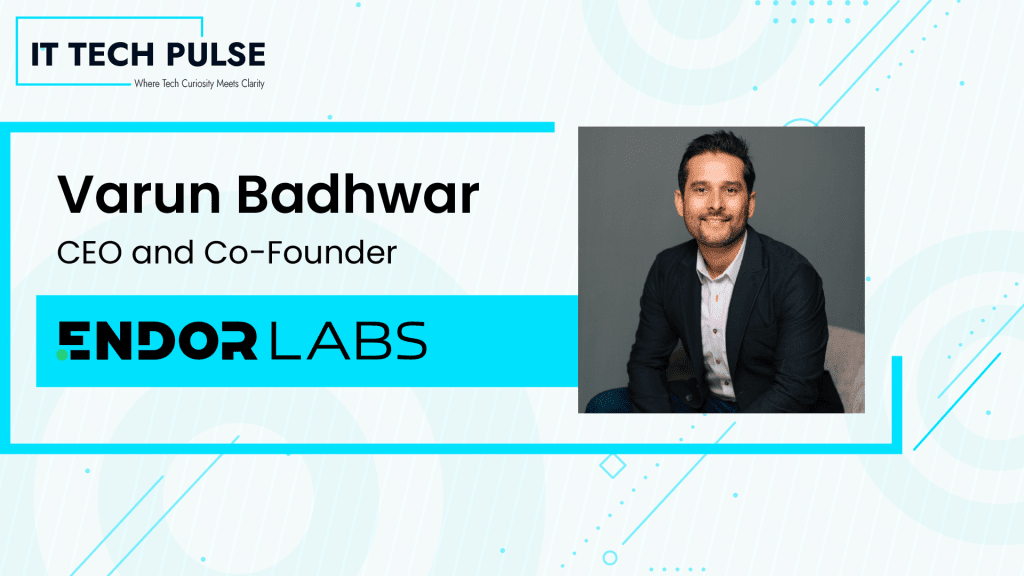
Varun Badhwar, CEO & Co-Founder of Endor Labs, in an exclusive ITTech Pulse interview, explains how AI-native visibility helps teams focus on real vulnerabilities and scale security effectively.
Varun, can you share your career journey from building RedLock (later acquired by Palo Alto Networks) and scaling Prisma Cloud to $300M ARR, to founding Endor Labs to automate open-source security risks for enterprises?
Earlier in my career at Palo Alto Networks, I had the opportunity to help scale Prisma Cloud during a time when cloud-native architectures were becoming mainstream. What became clear very quickly was that security teams were losing visibility into how modern applications were actually built.
Most applications today aren’t written from scratch—they’re assembled from thousands of open-source components, transitive dependencies, and increasingly AI-generated code. Traditional security tools were designed for a very different era of software development, so they tend to produce huge volumes of alerts without helping teams understand what actually matters.
That experience really shaped the vision for Endor Labs. We wanted to build a platform that helps engineering teams understand their entire software supply chain, identify which vulnerabilities are truly reachable in their applications, and fix the issues that actually pose risk. The goal isn’t just to find problems—it’s to help developers ship secure software at the pace modern organizations demand.
Read More: ITTech Pulse Exclusive Interview with Prabhu Ramachandran, Co-Founder & CEO of Facilio
With Endor Labs’ engineering team from Meta, Uber, and Amazon, what expertise or upcoming announcements position your platform as the leader in safe OSS adoption and AI-native AppSec?
The reality is that the hardest problems in application security today look a lot like large-scale distributed systems problems. Understanding how code flows across thousands of dependencies, services, and containers requires the same kind of engineering expertise that companies like Meta, Uber, and Amazon have developed to operate massive platforms.
Our team brings deep experience in static analysis, large-scale code graphing, and developer platform tooling. That allows us to analyze applications the way developers actually build them across repositories, packages, and containers.
As AI becomes a bigger part of software development, that expertise becomes even more important. AI tools are accelerating how quickly code is written, but they also introduce new layers of complexity in the software supply chain. Our focus is helping organizations adopt open source and AI-generated code safely by providing contextual risk analysis and developer-friendly remediation directly in their workflows.
Following ITTech Pulse’s coverage of Endor Labs acquiring Autonomous Plane, how does integrating Kyle Quest’s DockerSlim technology evolve your container reachability analysis beyond traditional scanning?
Traditional container security tools tend to focus on scanning images and flagging vulnerabilities in the packages they contain. The problem is that most of those vulnerabilities are never actually reachable in the running application.
Kyle Quest’s work with DockerSlim and Autonomous Plane introduced some very interesting techniques for understanding what code actually executes inside containers. By integrating that technology with our existing reachability analysis, we can connect the dots between source code, dependencies, and runtime container behavior.
The result is a much more accurate picture of risk. Instead of overwhelming teams with alerts, we can show which vulnerabilities are truly reachable from application code running in containers and which ones can safely be deprioritized. That level of precision is critical as organizations scale their container environments.
Our research shows full-stack reachability can filter 90% of false positives by tracing vulnerabilities from code through containers. How does this evidence- based visibility help enterprises prioritize real risks in AI-generated apps?
One of the biggest challenges security teams face today is alert fatigue. Many organizations are dealing with tens of thousands of vulnerability findings across their environments, but only a small fraction actually pose meaningful risk.
Full-stack reachability analysis changes the equation by tracing vulnerabilities from the original source code all the way through dependencies and containers to see whether they can actually be executed by the application.
In many cases, that analysis allows us to filter out the majority of findings that would otherwise appear critical. That means security teams can focus their time on the small subset of vulnerabilities that are actually exploitable.
As AI-generated code becomes more common, this becomes even more important. AI can dramatically increase the amount of code entering a codebase, which increases the number of potential security findings. Without contextual analysis, security teams simply won’t be able to keep up.
Read More: ITTech Pulse Exclusive Interview with Robert Wahbe’s is CEO at Highspot
As AI coding agents like GitHub Copilot accelerate development, how does Endor Labs’ AI Security Code Review and MCP Server detect/fix risks in PRs and IDEs without disrupting devs?
The key principle for us is that security needs to operate inside the developer workflow. Developers today are working in pull requests, IDEs, and AI-assisted coding environments. That’s where security insights need to appear if they’re going to be useful.
Our AI security code review capabilities analyze code changes in pull requests and identify issues like risky dependencies, vulnerable packages, or insecure patterns introduced by AI-generated code. Instead of producing long reports, the system surfaces clear remediation guidance directly where developers are already working.
Looking to 2026, with Gartner predicting 40% of apps embedding AI agents, what trends in agentic AI security like autonomous exploitation or self-improving threats do you foresee, and how is Endor preparing?
One of the biggest shifts we’re going to see is the rise of autonomous software behaviors. AI agents will increasingly write code, interact with APIs, and make decisions about how applications operate. That introduces entirely new security considerations, because the attack surface becomes much more dynamic.
We’re already seeing early signs of things like autonomous vulnerability discovery, AI-assisted exploitation, and self-modifying systems. That means security tools will also need to become more intelligent and adaptive.
Another major trend will be the expansion of the AI software supply chain. And I don’t just mean the code itself, but models, prompts, agents, and the infrastructure around them. Organizations will need visibility into all of those components to maintain trust in the systems they’re building. At Endor Labs, we’re preparing for that future by focusing on deep visibility into how modern applications are assembled and executed.
For ITTech Pulse readers adopting AI-native security, what one key advice would you offer on shifting from point-in-time scans to full-stack governance for compliant, scalable OSS and container management?
The biggest shift organizations need to make is moving away from point-in-time security scans toward continuous, full-stack visibility. Modern applications are constantly changing – developers are committing new code, dependencies are updating, containers are being rebuilt, and now AI systems are generating new components as well.
Security needs to evolve to match that pace. Instead of periodic scans, organizations should adopt platforms that can continuously analyze how their software is built and how it behaves in production. That’s the only way to maintain confidence in a world where software development is accelerating faster than ever.
Thank you, Mr. Varun, for taking the time to share your insights with us.
Write to us [wasim.a@demandmediaagency.com] to learn more about our exclusive editorial packages and programmes.
As a three-time company founder and luminary in the cybersecurity industry, Varun Badhwar represents the essence of disruptive entrepreneurship in Silicon Valley. He’s helped solve some of the most complex technology issues faced by global enterprises: His most recent venture, Endor Labs, takes on a critical yet overlooked corner of the technology market — the software supply chain and open-source security.
Before founding Endor Labs, where he also served as CEO, he was the founding GM and SVP of Prisma Cloud at Palo Alto Networks where he built the cloud-native security business from scratch to over $300M ARR in just three years. He joined Palo Alto Networks through the acquisition of RedLock, where he created the Cloud Security Posture Management (CSPM) category and sold the company three years later for over $200M. With a career spanning two decades, Varun Badhwar is a key player and influencer in technology and cybersecurity, including cloud computing and open source. He’s been a board advisor to dynamic entities like Tetrate and Safebreach, and always keeps his focus on the new, the important, and the neglected.
Endor Labs is the AI-native application security platform for teams that refuse to compromise between speed and security. helps teams identify, prioritize, and fix the vulnerabilities across source code, open-source dependencies, and container images. With deep program analysis, automated remediation, and unmatched coverage, Endor Labs empowers modern engineering and security teams to move fast without compromise.