AGI and Agentic AI: From Reasoning Models to Autonomous Enterprise Workflows
Stay updated with us
Sign up for our newsletter

Artificial intelligence is surpassing answering questions as it is being applied in business operations in an increasingly efficient manner. Businesses are beginning to employ and develop technologies that can carry out tasks, utilize software, gather information, and manage multi-step processes without requiring much direction from workers. This has led to the introduction of the notion of agentic AI, hence fuelling the larger debate around the possibility of the emergence of artificial general intelligence (AGI) in the future.
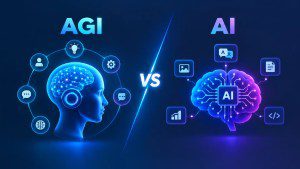
While these concepts are related, they cannot be viewed as synonyms. Agentic AI refers to the capability of an AI system to achieve a defined objective, and AGI refers to the level of general intelligence it can reach. An AI agent can realize certain tasks while lacking the ability to learn and adapt to new challenges like AGI.
Therefore, for the head of technology, it is important to understand the difference between these two concepts in order to differentiate between possibilities that will arise soon and opportunities provided by customers in the future.
How AGI and Agentic AI Differ
Agentic AI systems employ AI models to accomplish goals through a specific sequence of actions. Depending on design, they may decompose a request into subparts, choose among different tools, gather information, evaluate results, and iterate until attaining a specific final outcome.
AGI, on the other hand, refers to an academic debate that has not yet reached a consensus: the objective to create the intelligent problem-solver that can perform a wide range of intellectual tasks and adjust knowledge according to unfamiliar environments. No general agreed definition or test exists amongst researchers. This is where the assessment methods demonstrate the differences between the two.
- Agentic AI: Is the machine capable of performing a defined task or set of tasks under explicit conditions?
- AGI: Is the machine competent in handling a wide variety of exploratory capability in diverse domains and with unexplored problems?
In our article on what differentiates AI, generative AI, agentic AI, and AGI, there are ways that none are mutually exclusive; for corporate offices, agentic AI remains the more gear-and-operational question, while AGI provides a more far-reaching assessment of future AI capabilities.
From Reasoning Models to Autonomous Workflows
A reasoning model can help to work through a problem but reasoning doesn’t complete a business process. An agent is a combination of model capability and tools, instructions, data access and ability to take actions.
Let’s look at a delayed order. An average AI assistant would summarise the situation and recommend next steps. An AI agent may pull order details, check inventory levels, review supplier updates, draft a customer notification and route the case for approval. It may also update the order record based on its permissions .
The workflow is made of a number of associated processes:
- Define the purpose: Interpret task and establish what is expected to achieve
- Create a strategy: Split task into parts, decide which information or instruments to take advantage of
- Act: Get the files, ask systems or perform operations allowed in advance
- Analyze the results: Assess the output vis-a-vis the initial aim, establish what else may be required
- Seek human assistance, if necessary: In case the task is more complicated than allowed or beyond its certainty
It is important to note that the model is not universal since not all agents will be able to do the above operations properly. The key change is not the ability to answer but to coordinate the operations within the workflow.
Enterprise Adoption Is Moving Beyond Assistance
OpenAI’s August 2026 Enterprise Signals report describes a shift from AI assistance to delegated execution. Its analysis found the use of agentic AI is expanding beyond software development to sales, recruiting, legal work and marketing. The report also highlights a divide between organisations experimenting with AI and organisations embedding it more broadly into repeatable work.
This is a significant discovery, as enterprise value does not only depend on the level of quality of an AI-based answer. It is crucial for companies to have systems that can function in a real business environment, have access to relevant instruments and carry out useful activities.
Applications that could possibly be used are:
- IT: Follow up on alerts, gather information related to diagnostics, and prepare actions needed to solve issues.
- Customer Services: Retrieve account history, classify requests and manage responses.
- Finance: Collect invoice information, highlight problems, and submit issues.
- Sales: Create summaries, refresh customer information and manage follow-ups.
- HR: Assist with common policy questions and onboarding process.
These are all potential cases, and not an assurance of autonomous performance. The level of independence should depend on the complexity of the task, the sensitivity of the data and the consequences of an error.
Can AI Agents Lead to AGI?
AI agents may help with the development of better artificial intelligence systems. The main differentiating characteristics of the current generation of agents are their cognitive abilities: planning, reasoning, memory, use of tools, and ability to provide feedback.
However, it does not have to mean that agents are becoming smarter. Even a very complex process can be viewed as a process that is run by agents based on a particular model, a limited number of tools, or instructions. Agents may fail if the task to be performed is new or if the information available is not sufficient.
In our article titled “How closer we are to AGI by 2026” we explain why the advancement in skills alone does not mean that AGI is already here.
In the meantime, companies are recommended to evaluate the performance of the agents in terms of the tasks completed, errors made, the time saved, and adaptability to changed circumstances.
Governance Must Keep Pace With Autonomy
As agents gain entry to business systems, the focus has shifted from whether they can complete a task to whether they should be permitted to do so without oversight.
According to the World Economic Forum in its 2026 report named AI Agents in Action: A Playbook for Trusted Adoption, Authorization and Scaling, it is very important to legislate the permission of AI agents and but also control actions of agents as AI technologies are adopted.
In order to protect businesses against possible threats, firms should take several steps to create a proper security system.
Below are a few of them:
- Typed Permissions – agents should be given limited access to systems, files and transactions.
- Approval Points – decisions of relevance in terms of later finances and responsibilities must be approved by a human person.
- Audit Trails – there should be clear records of every action taken, tool utilized and decision made.
- Continuous Checking – performance of agents must be corrected via multiple checking of errors, mix-ups and attempts to break the rules.
- Accountability – every agent must have a clear manager responsible for its actions.
These elements are not a collection of preconditions which have to be met before AI gets fully implemented but rather represent the basic requirements for the creation of agent-based AI in an organized manner today.
Conclusion
Agentic AI is introducing real changes in enterprise technology since it is happening that AI systems are able to do more than just providing information – they can now also contribute towards completing work in all its stages. AGI continues to be the area of research that is yet to be resolved.
When it comes to companies, the main goal is to identify the processes where agents can generate measurable value, connect the processes with reliable datasets and systems, and determine the boundaries of the agents’ actions. These decisions will be important no matter how quickly AGI technology progresses.
Frequently Asked Questions
Is agentic AI considered an instance of AGI?
No. Agentic AI refers to technology that can act in order to accomplish a certain task. AGI is more about adaptive intelligence that is present in performing different tasks. An agent can function effectively even if it does not possess AGI capabilities.
What is the difference between AI agents and AGI?
AI agents are usually designed for solving specific tasks and processes. To prove AGI required wider ability and flexibility in solving different tasks.
Can AI agents help to create AGI?
While agent models may become a range of AGI technologies that mix reasoning, planning, memory and use of tools. Nevertheless, there are no proofs that creating more and more autonomous agents will lead to AGI.
How are companies using AI agents?
The list of possible uses includes but is not limited to offering IT support, assistance in customer service, finance operations, selling, and providing support to employees. Use of AI agents should be accompanied by special permissions and human control.
Write to us [wasim.a@demandmediaagency.com] to learn more about our exclusive editorial packages and programmes.