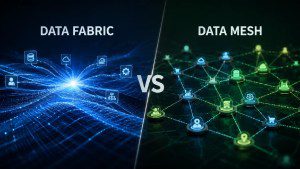
The Anatomy of a Data Fabric: How Enterprises Build an AI-Ready Data Foundation
Stay updated with us
Sign up for our newsletter

Most enterprises don’t have a data shortage. They have a data location problem. Customer records sit in a SaaS CRM, transaction data lives in an on-premises warehouse, product telemetry streams through a cloud event bus, and finance runs its own reporting database that nobody outside finance fully understands. Each system works fine alone. Together, they create an estate no single team can see across.
This is the gap a Data Fabric is meant to close, not by moving everything into one place, but by connecting what already exists.
What a Data Fabric Actually Is
A Data Fabric is an architectural approach, not a product you install. It connects distributed data environments, cloud platforms, on-premises systems, data lakes, warehouses, and operational databases through shared metadata, integration, and governance capabilities. It doesn’t replace these systems; it sits across them, making data easier to find, understand, and use without a migration.
The problem is rarely where data is stored. It’s whether the organisation can discover it, understand what it means, access it under proper controls, and trust it enough to build on.
Read: AI Governance Framework for Enterprises
The Anatomy of Data Fabric Architecture
At the source layer, a Data Fabric connects databases, business applications, SaaS systems, warehouses, lakes, and streaming platforms that stay physically distributed.
Data Integration is the connective layer. APIs, ETL/ELT pipelines, event streams, and replication move and expose data across these systems, but integration isn’t just transport. It makes data usable in context, whether that’s a batch report or a live application.
Metadata is the least glamorous and most important component. Catalogs, lineage tracking, and automated discovery tell users what a dataset means, where it originated, who owns it, and how it has changed. A Data Fabric becomes useful when engineers can understand a dataset without tracking down whoever remembers how it was built.
Data Management handles the operational side, lifecycle, storage, transformation, and availability, keeping data usable as it evolves across the fabric.
Data Governance establishes ownership, access policy, and accountability. Data Quality determines whether any of it is trustworthy, measured through accuracy, completeness, consistency, and timeliness. Connecting more systems doesn’t automatically produce better data; it just makes bad data easier to find faster.
Why AI Needs a Data Fabric
AI systems, machine learning models, RAG pipelines, agentic, workflows, are only as reliable as what they retrieve. A Data Fabric doesn’t automatically create AI-Ready Data, but it provides the scaffolding, discovery, lineage, governed access, and quality controls that make reliable retrieval possible. AI exposes weak data foundations quickly, since models consume flawed information at machine speed without hesitation.
Enterprise Data Fabric in Practice
In financial services, customer, transaction, and risk data often live in separate systems with separate owners. An Enterprise Data Fabric can connect these sources for analytics while preserving lineage and compliance boundaries. In retail, inventory and supply chain data spread across platforms benefit similarly through connected access without full platform consolidation.
Read: Enterprise AI Readiness Assessment: A Practical Framework
Building It Without Creating Another Silo
Enterprises that succeed don’t try to connect everything at once. They start with a high-value domain, clear ownership, and a defined use case, then expand based on measurable outcomes. This requires ongoing collaboration between data engineering, security, governance, and business teams, since architecture alone doesn’t resolve organisational ambiguity.
Industry Perspective
Enterprises are shifting from isolated lakes, warehouses, and point-to-point integrations toward connected architectures supporting real-time analytics and growing AI workloads. Multi-cloud sprawl and the demand for governed, traceable data at scale are pushing Data Fabric Architecture from theory into a practical necessity for data leaders managing fragmented estates.
FAQs
What is a Data Fabric?
An architectural approach connecting distributed data through integration, metadata, governance, and data management capabilities.
How does a Data Fabric support AI?
It makes enterprise data more discoverable, governed, and traceable, strengthening the foundation AI workloads depend on.
Is a Data Fabric the same as a data lake or warehouse?
No, it connects and governs data across existing repositories rather than replacing them.
Conclusion
A Data Fabric is an architecture, not another repository. Integration alone doesn’t solve the problem; metadata, Data Management, Data Governance, and Data Quality turn connected data into a dependable foundation for enterprise AI and analytics.