

ITTech Pulse Exclusive Interview with Dr. Petar Tsankov, Co-Founder and CEO of LatticeFlow AI
Stay updated with us
Sign up for our newsletter
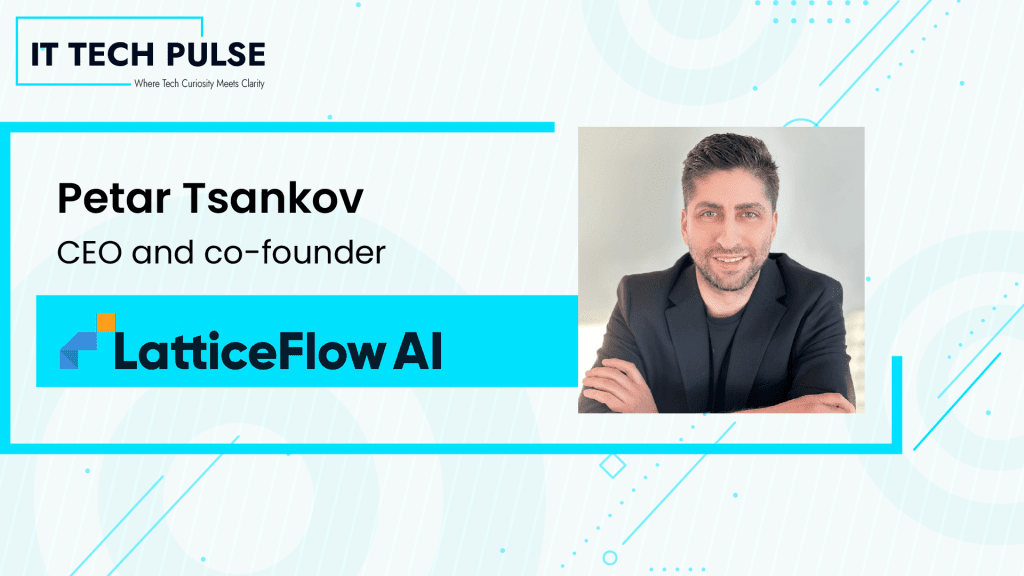
Petar Tsankov, in an exclusive interview with ITTech Pulse, highlights how evidence-based governance, continuous validation, and AI visibility empower enterprises to bridge policy gaps, ensuring trustworthy, scalable, and compliant AI systems.
Hi Dr. Tsankov, welcome to the IT Tech Pulse Interview series. Could you briefly describe what LatticeFlow AI does and the core problem it solves in the enterprise AI lifecycle?
LatticeFlow AI is a leader in enabling evidence-based AI governance, allowing enterprises to translate AI principles, regulatory requirements, and internal policies into measurable technical assessments that generate verifiable evidence on the security and performance of AI systems.
The core problem in the enterprise AI lifecycle is the gap between governance requirements and technical implementation. Organizations define frameworks and policies, but they cannot consistently demonstrate that their foundation models, LLMs, or agentic systems are safe, reliable, and compliant in practice. Governance remains declarative instead of operational.
We close this gap. With LatticeFlow AI GO!, we deliver deep technical assessments across risk, performance, and compliance dimensions, before deployment and continuously in production. Following the acquisition of AI Sonar, we extend this further by providing visibility into where and how AI is used across the enterprise.
In short, we consider AI governance a technical discipline: grounded in evidence, designed to be operational, and built to scale.
From your perspective, what are the major risks or blind spots enterprises encounter when using AI in mission-critical operations, and how does LatticeFlow AI help resolve them?
A major risk in mission-critical AI is what I call AI governance theater: the appearance of oversight without technical evidence.
Many organizations have policies, review boards, and documentation in place. But once systems are deployed, there is no insight into how models behave under real-world conditions, how vulnerabilities are tested, or whether safeguards are effective. The governance framework exists, yet the technical reality remains unclear.
This is especially critical with foundation models and agentic systems, where behavior can shift depending on context, data, and integration complexity.
We address this directly. LatticeFlow AI Sonar provides transparency around where and how AI is used. LatticeFlow AI GO! then applies systematic model evaluations that make system behavior observable and continuously assessable in production.
Effective AI governance is not about documentation: it is about measurable control at the technical level.
Read More: ITTech Pulse Exclusive Interview with Mark Wojtasiak is SVP of Product Research and Strategy at Vectra AI
How do you define “trustworthy AI” for modern enterprises, and why has it become a top priority for CIOs and CTOs?
For me, trustworthy AI is a property of the system.
An AI system is trustworthy when its behavior is reliable, predictable within defined boundaries, and subject to technical control. That means we understand how it performs, where its limitations are, how it reacts under stress, and how risks are systematically tested and mitigated.
Trustworthy AI is therefore an engineering outcome. It requires structured evaluation, continuous monitoring, and measurable safeguards, especially when systems operate in regulated or mission-critical environments.
This has become a top priority for CIOs and CTOs because AI is now embedded in core processes. It affects financial decisions, customer interactions, and compliance exposure. At that level, uncertainty is a business risk.
Executives are realizing that trust cannot be assumed. It must be demonstrated through technical rigor and ongoing oversight.
What strategic gap in enterprise AI governance did the acquisition of AI Sonar help you address immediately?
The strategic gap was visibility and control at enterprise scale.
Many organizations attempt to govern AI without a reliable inventory of where models are embedded, how APIs are used, or which third-party tools introduce AI capabilities into their environment. Shadow AI and unmanaged integrations create blind spots, particularly in regulated and security-sensitive settings.
AI Sonar is closing that gap. It provides systematic discovery of AI usage across the enterprise, including in complex, hybrid, and on-prem environments where data sensitivity and security constraints are critical.
This is fundamental. Governance must start with awareness and control. By combining AI Sonar’s discovery capabilities with our technical evaluation platform, we will offer enterprises a secure, on-prem-ready approach that moves from visibility to enforceable oversight.
Where do you see the biggest innovation opportunities in AI trustworthiness over the next 3–5 years? How does LatticeFlow position itself to lead in that future?
The next wave of innovation in AI trustworthiness will be about scalability.
Over the next three to five years, enterprises will move beyond validating individual models. They will need mechanisms to govern entire AI ecosystems, including foundation models, fine-tuned variants, agentic systems, and third-party integrations. All of it, in dynamic, real-time environments.
In that sense, trustworthiness will evolve from one-off evaluation to continuous assurance. Governance will become adaptive: systems will need to be stress-tested automatically, monitored for behavioral shifts, and aligned with changing regulatory and operational requirements.
We position ourselves at the center of that shift. Evidence-based AI governance is about building the infrastructure that makes AI governance operational and scalable across the enterprise. By combining systematic discovery with structured technical validation, we are laying the foundation for governance that scales with AI complexity.
In the future, trust will definitely be a property of the entire AI architecture.
How does AI discovery change the way organizations manage risk across traditional, generative, and agentic AI systems?
AI discovery fundamentally changes risk management because it shifts it from reactive to proactive and structural.
In traditional AI environments, risk was tied to known models that were centrally developed and documented. With generative and agentic AI, usage becomes decentralized. Models are embedded via APIs, integrated into SaaS tools, fine-tuned locally, or orchestrated dynamically across workflows. Risk exposure expands faster than governance processes can track.
AI discovery provides a continuously updated view of where AI is present, how it is integrated, and which systems depend on it. That visibility transforms risk management from a manual, project-based exercise into an ongoing capability.
For generative AI, this means understanding which models are interacting with sensitive data. For agentic systems, it means mapping decision flows and identifying autonomous actions. For traditional AI, it means ensuring legacy models are not operating outside approved parameters.
Without discovery, governance operates on assumptions. With discovery, risk management becomes grounded in the actual AI footprint of the organization.
In an environment of rising AI regulation, how is LatticeFlow AI helping enterprises operationalize ethical, explainable, and compliant AI governance at scale?
AI governance at scale is not fundamentally about regulation. It is about operational control.
Regulation may accelerate the conversation, but the real driver is adoption. As AI becomes embedded in core business processes, organizations need systems that are reliable, controllable, and aligned with enterprise standards.
The challenge is scalability. Governance cannot rely on manual reviews, static documentation, or one-off assessments. It must become a repeatable, system-level capability embedded into how AI is built and operated.
That is where we focus. We enable enterprises to operationalize and scale AI governance through structured discovery, systematic technical validation, and continuous oversight across their AI landscape.
When governance becomes operational and scalable, trust follows. And trust is what ultimately enables responsible AI adoption at enterprise scale.
Read More: ITTech Pulse Exclusive Interview with Eric Schwake, CISSP, Director of Cybersecurity Strategy at Salt Security
When CIOs and CTOs begin adopting AI, what foundational steps should they take to ensure their initiatives are secure, trustworthy, and aligned with business goals?
AI adoption rarely follows a perfectly centralized, top-down plan. In practice, it tends to expand horizontally across teams and business units.
Developers experiment with APIs, product teams integrate generative capabilities, and business functions adopt AI-enabled tools independently. This decentralized momentum accelerates innovation, but it also increases complexity and risk exposure if not managed properly.
For CIOs and CTOs, the foundational step is therefore not just defining governance principles, but establishing visibility and technical control early on.
That means three priorities:
- First, gaining clarity on where and how AI is being used across the organization.
- Second, implementing structured evaluation mechanisms to assess model behavior and risk.
- Third, embedding continuous oversight into operational workflows rather than relying on periodic reviews.
When AI spreads organically, assumptions are no longer sufficient. Trust must be grounded in technical validation.
Thank you, Petar Tsankov, for taking the time to share your insights with us.
Write to us [wasim.a@demandmediaagency.com] to learn more about our exclusive editorial packages and programmes.
LatticeFlow AI sets a new standard in AI governance through deep technical assessments that enable evidence-based decisions and empower enterprises to accelerate AI adoption with confidence. As the creator of COMPL-AI, the world’s first EU AI Act framework for Generative AI developed with ETH Zurich and INSAIT, the company combines Swiss precision with scientific rigor to operationalize AI governance built on evidence and trust.