
IT Tech Pulse Exclusive Interview with Scott Downes, CEO and Founder Supernal AI
Stay updated with us
Sign up for our newsletter
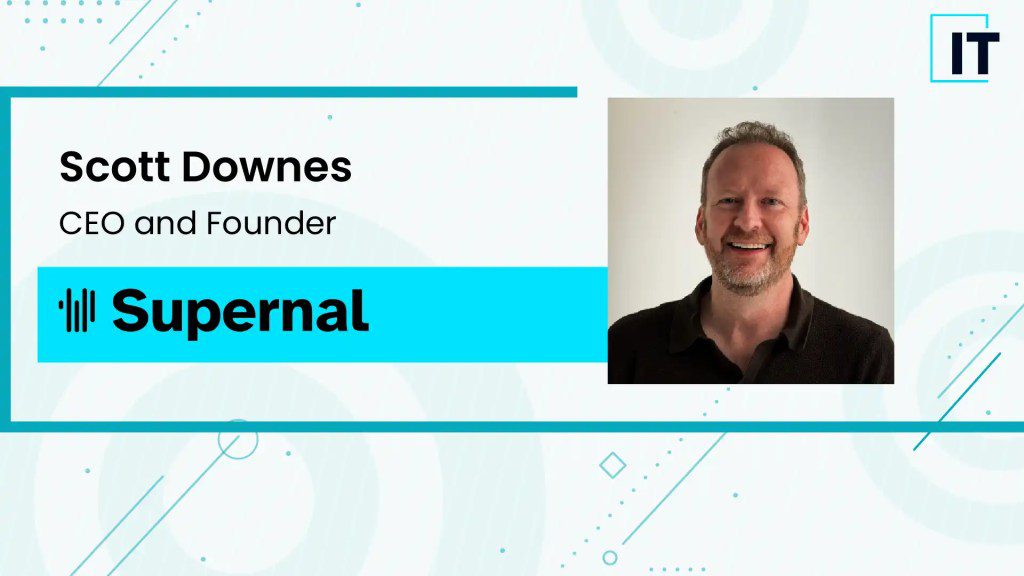
Scott Downes, CEO and Founder of Supernal AI, discusses why AI should augment human potential, how AI employees and operating systems will reshape businesses, and why human judgment must remain at the center of agentic AI.
You have built through the dot-com web, the iPhone’s mobile shift, and frontier model training at Invisible, yet you studied literature, not engineering. How did that unlikely mix shape Supernal’s founding thesis?
I think this is a great moment for the generalist. For a long time, people were rewarded for becoming extremely specialized – the best person in one narrow technical discipline. My own career never really worked that way. I have always been drawn to the intersections between technology, business and creative work. AI is now breaking down many of the silos inside organizations, so the ability to step back, understand the whole system and connect disciplines becomes incredibly valuable. That perspective shaped Supernal. We are not interested in dropping a piece of technology into one department and calling the job done. We want to understand the business holistically and build AI around the way the company creates value.
You’ve said empathy, not engineering, is the real ingredient in scaling AI. What does the current AI conversation obsessed with productivity metrics fundamentally miss about what makes people feel more alive at work?
Productivity matters, but it is not the whole point. People want to feel agency, mastery and a connection to why they are doing the work in the first place. Over time, companies accumulate systems, processes and organizational silos that can push people farther away from that. The best role for AI is not simply to squeeze another percentage point of output from someone. It is to remove friction and complexity so people can spend more time using judgment, creativity and the broader range of abilities that make work meaningful. I think AI can be a very good moment for the generalist – the person who can see across functions and bring more of themselves to the work.
Thorne Protocol’s AI agent didn’t write the story, it ran mood boards, shot lists, and post-production coordination while humans acted and directed. What did that division of labor teach Supernal about where agents actually belong?
It reinforced a thesis we already had that the best role for AI is to support humans doing the things humans do best. Thorne Protocol was a useful proof point because filmmaking is a field people assume must be entirely human driven to remain meaningful. The AI could support planning, coordination and process, while humans remained responsible for the story, performances and creative decisions. That is the model we believe in more broadly. AI should increase the reach and capability of talented people while humans remain in charge.
Future Vision XPRIZE explicitly bars fully AI-generated films, requiring a human storyteller in the loop. Is that rule a temporary guardrail the industry will outgrow, or a permanent design principle Supernal builds around?
I see the human in the loop as a permanent design principle, not a temporary constraint. Technology without guardrails or guidance can spin off in directions that are disconnected from the outcome people want. The goal should not be maximum automation for its own sake. It should be using AI where it creates leverage while preserving human judgment over the objectives, values and creative decisions that define the work.
Supernal has shifted its language from ‘AI employees’ to ‘AI operating layer’ while targeting hundreds of mid-market clients. What has to change inside a legacy business before an AI operating system can actually work?
I would clarify the premise slightly. We have not moved away from the idea of AI employees. We still see AI employees as a critical part of the model. What we learned is that, to be truly effective, those AI employees need a place to live and operate. That is the AI operating system. Inside a legacy business, the first change is conceptual — stop starting with a software category and start with the business outcome. You have to understand the company’s processes, systems, data and objectives well enough to give AI a structured environment in which it can act. The operating system provides that foundation, and the AI employees become the interface and actors operating on top of it.
Frontier labs are absorbing most 2026 AI investment while mid-market businesses remain comparatively underserved. Within three years, will AI agents inside legacy companies be treated as infrastructure, or will they still feel like software?
I do not think they will feel like either. I think they will feel like teammates. People will look at an org chart and see humans alongside AI agents performing defined roles, and that will stop feeling unusual. That is also why I think the mid-market opportunity is so important. These companies may not have enormous internal AI teams, but they have the same operational complexity and many of the same opportunities to benefit from the technology.
As agentic AI gets more capable, many leaders default to either full automation or cautious resistance. What’s the discipline you’d urge founders to practice to keep human judgment central as AI takes on more?
Stay relentlessly focused on the actual objectives and metrics of the business. We have all become accustomed to the idea that certain technology purchases are simply required – that a ‘real’ company must have a particular stack of systems. I would approach AI with something closer to zero-based budgeting: do not spend a penny or automate a process until you can explain what outcome it delivers. Start with the goal, then decide what humans should own and where technology can create leverage. Technology should serve the business, not dictate how the business operates.
Supernal builds around a company’s existing IP, relationships, and processes rather than standardized templates. What’s the real risk businesses face in losing that identity once AI systems start running core operations?
I would argue that properly built AI systems reduce the risk of losing that identity. For years, companies have bought standardized software and then changed their processes to fit someone else’s idea of how a business should run. AI creates the possibility of customization at scale. It is the difference between buying off the rack and having a bespoke suit made for you. The technology can reflect the company’s own values, processes, relationships and intellectual property rather than forcing the company into a generic template. The risk comes when AI is deployed without that context. Built correctly, it can help preserve the identity that made the business valuable in the first place.
Thank you, Scott Downes, for taking the time to share your insights with us.
Write to us [wasim.a@demandmediaagency.com] to learn more about our exclusive editorial packages and programmes.
Scott Downes is a seasoned technology executive with deep expertise in scaling AI-powered operations. As former CTO of Invisible Technologies—ranked #3 on the Inc. 5000 fastest-growing AI companies—he led the team and platform that brought the company to global scale and $134M in revenue. He also served as CTO at Infinity Constellation, the world’s premier incubator for AI-enabled services. At Supernal, Scott is on a mission to bring the transformative power of modern AI to small and medium-sized businesses.
Supernal brings the power of AI to small businesses. Talk to us and hire your first AI employee today.