IT Tech Pulse Exclusive Interview with Rajan Sethuraman, Chief Executive Officer of LatentView Analytics
Stay updated with us
Sign up for our newsletter
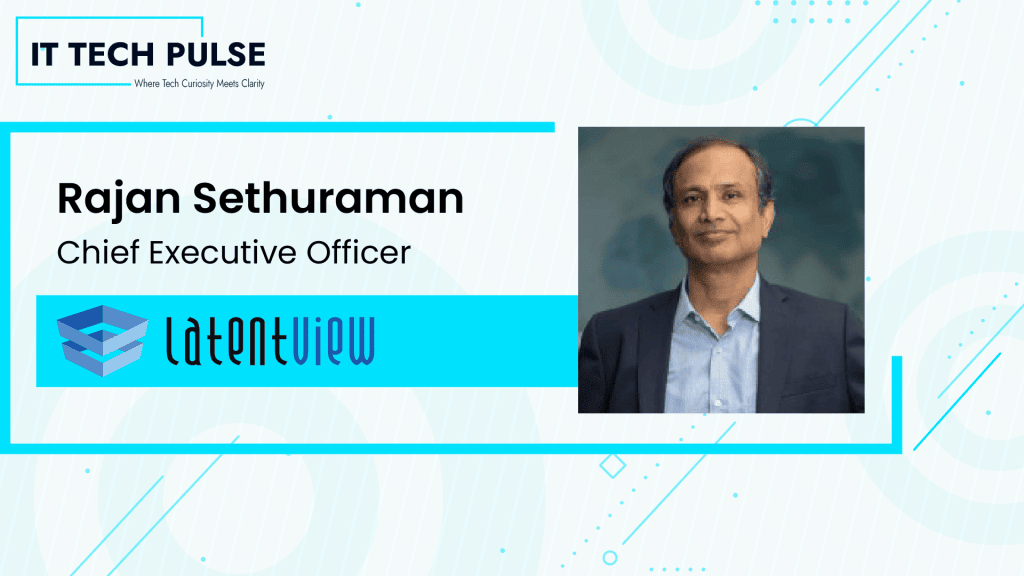
Rajan Sethuraman, CEO of LatentView Analytics, discusses how strong data foundations and AI governance help enterprises scale GenAI beyond experimentation.
Hi Rajan, our audience would love to know about your professional journey, early roles at KPMG and Accenture, and how you’ve shaped LatentView into a global leader in data analytics since becoming CEO in 2019?
Early in my career at KPMG and Accenture, I spent a lot of time inside large enterprises that were investing heavily in digital systems. What struck me was that while companies had plenty of data, the connection between that data and real decision-making was often weak. Teams were generating reports, but those insights rarely flowed into the operating rhythm of the business. When I became CEO of LatentView in 2019, my focus was on helping organizations close that gap. We expanded our work in data engineering and AI so that analytics could sit much closer to the point where decisions happen. Today, we work with companies across sectors like retail, consumer goods, financial services, and technology, where analytics often supports real operational questions such as marketing performance, product innovation, and supply chain planning.
Read More: ITTech Pulse Exclusive Interview with Stanley R. Hughey, Chief Technology Officer at iNet
What core expertise in AI, data engineering, and GenAI do you bring to LatentView’s mission, and how has it influenced innovations like LASER for business breakthroughs or AI Penpal for conversational analytics?
My perspective on AI has always been shaped by practical implementation. The model itself is rarely the hardest part. The actual challenge is connecting enterprise data, applying analytics that produce meaningful signals, and giving business teams a way to interact with those insights. LASER is a good example of that thinking. Many organizations have large volumes of internal knowledge spread across documents, research repositories, and internal systems. LASER uses AI-powered search and natural language capabilities to help employees find and analyze that information more easily. AI Penpal addresses a different challenge. It uses generative AI to help companies understand customer preferences and generate personalized communications that support marketing engagement.
Following LatentView’s recent addition of Kiran Muddana – ex-Google and Amazon executive – to your AI Advisory Council, how will his deep learning and cloud expertise accelerate client transformations in agentic AI and data platforms?
Kiran has spent years building AI systems in environments like Google and Amazon, where scale and reliability are non-negotiable. That experience is extremely valuable as enterprises start thinking about AI not as isolated projects but as part of the core platforms that run their businesses. Many of our clients are working through how to integrate data platforms, AI models, and cloud infrastructure into a system that supports decision-making across the organization. Leaders who have operated AI systems at global scale bring a practical perspective on how those architectures should be designed and governed.
Our team reviewed LatentView’s Q3 FY26 concall highlighting 20%+ growth in tech/retail verticals and the Decision Point acquisition – how are these moves strengthening your GenAI pipeline for enterprise clients?
Retail and technology companies tend to move quickly because their businesses generate constant signals about customers and demand. That creates a natural environment for analytics and AI to drive decisions across marketing, supply chains, and commercial planning. The Decision Point acquisition has further strengthened our position, particularly in commercial analytics and revenue growth management for consumer goods and retail. It also brought proven AI-led assets such as BeagleGPT, a conversational GenAI application built for Microsoft Teams that helps Fortune 500 CPG organizations democratize access to analytics and drive greater data adoption across business teams. When you combine that domain expertise with strong data engineering and AI capabilities, you start to unlock much more powerful use cases. Generative AI becomes far more valuable if it sits on top of deep analytics and real business context rather than isolated datasets.
Looking ahead to 2026, what are your top predictions for data engineering trends like multi-cloud MLOps, enterprise GenAI scaling, and AI governance, and how is LatentView positioning itself to lead in these areas?
One of the biggest conversations we’re having with clients today is about moving beyond AI pilots. Many organizations have experimented with generative AI over the past couple of years. The challenge now is integrating those capabilities into the systems and processes that run the business. That requires stronger data foundations than many companies initially expect. Enterprises are managing large volumes of data across multiple platforms, and AI systems need reliable pipelines, governance, and monitoring to operate effectively. Scaling AI is not only about deploying models but about building the infrastructure and discipline that allow those models to support real decisions across the organization.
Read More: ITTech Pulse Exclusive Interview with Stanley R. Hughey, Chief Technology Officer at iNet
How is LatentView measuring ROI from tools like ConnectedView in real client deployments, especially amid 2026’s focus on cost-efficient agentic AI over hype-driven pilots?
ConnectedView focuses on improving supply chain visibility by bringing together demand, supply, and logistics data so organizations can plan and respond more effectively. The solution uses analytics to help companies monitor demand signals, identify potential disruptions, and support planning decisions across the supply chain. In practice, clients evaluate its impact through improvements in areas such as demand forecasting, supply planning, and operational visibility. These capabilities help teams coordinate demand and supply decisions more effectively and respond faster when market conditions or supply chain dynamics change.
When you look at organizations that are actually making AI work at scale, what separates them from those that are still stuck in experimentation?
The difference shows up in how seriously they treat the basics. The companies that are moving forward have spent time getting their data into a usable state and aligning teams around a few high-impact problems instead of chasing too many ideas at once. They are also very clear about where AI should and should not be applied. Not every process needs it. The focus is on areas where better decisions can materially change outcomes, whether that’s improving demand planning, refining customer targeting, or accelerating product development. What stands out is consistency. These organizations don’t treat AI as a one-time initiative but build the data pipelines, governance, and operating discipline needed to support it over time, and they keep refining how it is used across their business. That consistency is what ultimately turns AI from a set of experiments into something that the business relies on every day.
Thank you, Mr. Rajan, for taking the time to share your insights with us.
Write to us [wasim.a@demandmediaagency.com] to learn more about our exclusive editorial packages and programmes.
Rajan Sethuraman is the CEO of LatentView Analytics, trusted analytics partner to the world’s most recognized brands. Rajan’s current focus is on building deeper industry expertise, consulting capabilities and a suite of products aimed at helping leading Fortune 500 organizations leverage the power of data and analytics in addressing high priority challenges and opportunities.
Rajan has over 20 years of consulting experience in business strategy, supply chain management, analytics, operational improvement, information technology, talent management and forensic services working with the strategy management consulting practices of Accenture and KPMG. He has also worked with several Indian and multinational organisations in the Oil & Gas and Metals and Mining sectors on a broad spectrum of strategic and operational initiatives.
Post his management consulting career, Rajan led Talent Acquisition for Accenture’s Global Delivery Network for Technology in India. He was also the HR Analytics Lead responsible for the adoption of a scientific approach to HR process improvement based on data and analytics. Rajan holds a bachelor’s in engineering from the Birla Institute of Technology and Science, Pilani, and a Post Graduate Diploma in Management from the Indian Institute of Management Calcutta.
LatentView Analytics is an AI-driven analytics, data engineering, and consulting firm that inspires and transforms businesses to excel in the digital world by harnessing the power of data. We provide a 360° view of the digital consumer, enabling companies to predict new revenue streams, anticipate product trends and popularity, improve customer retention rates, and optimize investment decisions. We are a trusted partner to enterprises worldwide, including 50 Fortune 500 companies in the Technology, Financial Services, CPG, Retail, Media and Entertainment, and Healthcare sectors. We have clients across the United States, Germany, the UK, the Netherlands, Singapore, and India, supported by a talented team of over 1,750 professionals. With the acquisition of Decision Point Analytics, we have expanded our global presence in the LATAM region and strengthened our capabilities in the CPG sector.