

ITTech Pulse Exclusive Interview with Brad Murdoch, Chief Executive Officer of Deskpro
Stay updated with us
Sign up for our newsletter
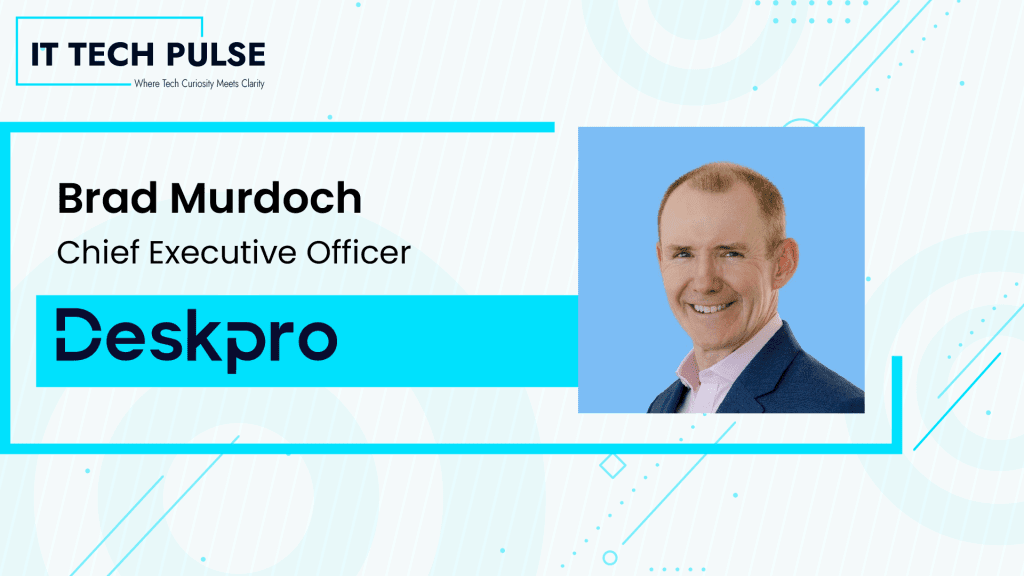
Brad Murdoch, CEO at Deskpro, shares with ITTech Pulse how AI-assisted support tools are improving productivity without replacing human agents.
Brad, your career spans enterprise software and customer experience platforms. Could you share how your professional journey led you to Deskpro and what inspired your focus on transforming modern help desk technology?
I’ve spent the last 20 years working with early-stage and growth-stage B2B software companies and got involved with Deskpro through my work as an operating advisor for a private equity firm that took a majority stake in the company.
On paper, the help desk market looks saturated, but Deskpro has quietly built something very differentiated: Deskpro Private. A platform that can be deployed in truly private environments, including virtual private clouds, sovereign clouds, on-premises, or even in air‑gapped environments for organizations operating in highly regulated environments.
Then I looked at the AI opportunity. Everyone intuitively understands customer service is one of the most compelling use cases for AI, and there’s an untapped market of organizations that care deeply about security, compliance, and data sovereignty who cannot use typical cloud‑only AI offerings. These companies want the productivity gains and customer experience improvements AI can offer, but they’re blocked by where and how the AI runs.
Deskpro Private changes that equation. We make it possible to bring modern, AI‑powered help desk capabilities into environments that security and compliance teams will sign off on.
This combination of a differentiated deployment model and pragmatic AI story is what convinced me Deskpro wasn’t just another help desk vendor. It was an opportunity to address a clear market need and help define what a secure, modern help desk platform should look like.
Read More: ITTech Pulse Exclusive Interview with Stanley R. Hughey, Chief Technology Officer at iNet
With AI transforming customer and employee support operations, how do you see modern help desk platforms evolving to balance automation, operational efficiency, and meaningful human interaction across enterprise service environments?
AI is already reshaping customer and employee support, but it’s important to think of AI adoption as a journey, not a light switch. The vendors selling “fully autonomous AI agents” are getting ahead of what the technology can reliably deliver in production. Customer satisfaction scores for AI agents handling complex interactions are sitting around 30%, compared to 80-90% for human agents.
What I’ve seen work in our own support operations and with customers is AI doing what it’s genuinely good at: drafting ticket replies, summarizing long conversation threads, routing tickets based on intent and sentiment, and deflecting repetitive queries through self-service. Those use cases are real and the productivity gains are measurable. They’re not replacing human agents; they’re freeing employees to focus on solving the more complex problems that require empathy and creativity.
I think the short-term evolution of AI will be more about infrastructure than capability. Help desk platforms need to get serious about where data is processed, how AI connects to enterprise systems and what happens when AI has access to sensitive customer records.
Right now, most help desk platforms are built for companies who don’t have strict data security or sovereignty requirements and can use public cloud AI services. The next wave of innovation needs to focus on serving the organizations that need added security measures to ensure compliance. These are organizations operating in regulated industries, multinationals navigating data sovereignty laws, and government agencies.
ITTech Pulse recently covered Deskpro launching Cloud and Private deployments in AWS Marketplace. What motivated this move, and how does marketplace availability help enterprises accelerate adoption of modern support platforms?
The AWS Marketplace solves a friction point for enterprise buyers. Large organizations have procurement processes, compliance reviews, and budget cycles that can drag software purchases out for months. Many companies have committed AWS spend they need to draw down, and being available in the AWS Marketplace means Deskpro plugs directly into existing procurement workflows.
For Deskpro Private specifically, many of our target customers are already running their core infrastructure in AWS. Deploying Deskpro into their own AWS environment, whether that’s via a standard VPC or, for European organizations, the AWS EU Sovereign Cloud, means their data stays within the security perimeter they’ve already built and approved. That’s a much easier conversation with a security team than asking them to evaluate a brand-new vendor’s cloud infrastructure–and all of the associated AI services–from scratch.
Deskpro now supports both cloud and private deployment models. How important is deployment flexibility for enterprises, particularly those operating in regulated industries with strict data security, compliance, and infrastructure requirements?
Deployment flexibility is the difference for many in being able to use AI or not. Our recent research found 81% of organizations rate security as their top concern when adopting AI-enabled support tools, and 78% have their IT or security team involved in the final purchasing decision, giving them veto power over AI projects.
Organizations operating in regulated industries with strict data security, compliance, and infrastructure requirements typically fall into three categories.
The first category are those who can use a VPC (virtual private cloud) with encrypted communications to AI foundation models. This model works for many regulated organizations, including financial services firms and healthcare systems.
In the second category are organizations who can use a sovereign cloud or other private cloud with shared access to the AI foundation models. All the data remains within an appropriate geographic or regional boundary. This suits many organizations subject to specific data sovereignty and privacy requirements.
The final category is a fully private deployment where Deskpro Private and a private foundation model are deployed entirely within an organization’s own environment, such as a private data center, colocation facility, or air-gapped environment. This configuration is required for organizations with the most stringent requirements, such as government agencies, aerospace and defense contractors, and other organizations with strict security mandates.
Read More: ITTech Pulse Exclusive Interview with Chris Ciabarra Co-Founder and Chief Technology Officer at Athena Security
AI-driven automation is reshaping help desk operations through chatbots, smart routing, and agent assistance. How do you see these capabilities changing service delivery and productivity for enterprise support teams?
AI has the potential to add tremendous business value for CX and EX teams, but businesses won’t recognize that value if their employees are reluctant to use it. I can speak from my own experiences at Deskpro, because we run our own support on Deskpro and had that experience when we trialled our own AI capabilities.
When we rolled out AI help desk capabilities to our own support team, there was an initial degree of pushback over the concern that AI might replace them. However, after seeing how it could help make their jobs easier, by drafting replies, summarizing tickets, creating knowledge base articles, and dramatically reducing the number of tickets they had to handle, our support team now refuses to let us turn it off. The key was demonstrating that AI is an assistant, not a replacement for the human empathy, compassion, and problem solving that’s needed for great CX and EX.
Deskpro Private enables organizations to deploy help desk infrastructure within their own environments. How does this model address enterprise concerns around security, data sovereignty, and control while still enabling AI-powered support capabilities?
The core problem we’re solving is that most AI-powered SaaS solutions send data over public cloud infrastructure to foundation models that live in a public environment. For the majority of organizations that’s acceptable: the hyperscalers’ security models are genuinely solid. But for regulated industries, any data flowing out of their security perimeter to a third-party AI provider has the potential to create compliance violations.
Deskpro Private solves this by giving customers the option to deploy Deskpro into their own secure, compliant environment. Then, the foundation models can be accessed via secure private links within the cloud provider’s network, or the customer can use their own foundation models and run everything within their own security perimeter. Models like Cohere, Mistral, Llama, and DeepSeek all offer on-premises deployment options.
These private deployment options finally give organizations the control and security they need to tap into the productivity benefits of AI.
Looking forward, what major trends do you expect to shape AI-powered customer support, enterprise help desk platforms, and infrastructure deployment as organizations continue modernizing their digital service operations?
There are a few things I’m watching closely. First, the autonomous agent narrative is going to face a reality check. We’re seeing many in the industry go very hard on agentic AI marketing, but the underlying customer satisfaction numbers don’t support it yet. I expect more public failures, which will push organizations toward the more measured approach: AI assisting humans rather than replacing them.
Vertical and private foundation models are also going to get more interesting. General-purpose models are extremely capable, but they’re also enormous and expensive to run. An insurance company doesn’t need a model that can discuss aerospace engineering; they need something precisely trained on insurance data that runs efficiently in their own environment. As smaller, more specialized models get better and cheaper to run, the economics of private deployment shift significantly.
AI security is now moving from a checkbox item to a competitive differentiation. Right now, most help desk vendors don’t talk about it enough, if at all. That’s going to change as prompt injection attacks and PII leaks start generating more headlines about organizations that got burned by their third-party SaaS vendor. The companies that have built security into their AI architecture from the start will be in a much better position than those retrofitting it later.
For CX and technology leaders planning to modernize their support infrastructure, what advice would you offer to successfully adopt AI-enabled help desk platforms while maintaining security, operational efficiency, and strong customer trust?
Stop believing you’re behind. That’s the first thing. More than half of organizations are still in pilot or planning stages with their AI deployments and haven’t moved anything to production. The industry narrative is not the market reality.
When it comes to picking a platform, get your security and compliance teams involved at the start of the procurement process, not after you’ve picked a vendor. Then, start with a single, contained use case that can prove AI’s value before expanding to anything more complex or that deals with sensitive data.
Don’t forget to talk to your workforce. Sixty-one percent of workers believe AI could replace their role within the next three to five years. If you deploy AI tools without being transparent about why, properly training your team and honestly addressing concerns, adoption will stall.
Thank you, Mr. Brad, for taking the time to share your insights with us.
Write to us [wasim.a@demandmediaagency.com] to learn more about our exclusive editorial packages and programmes.
Brad Murdoch is the CEO of Deskpro, a secure AI-powered help desk platform for customer and employee support. A veteran B2B tech leader, Brad has spent more than two decades helping companies scale from early-stage to commercial enterprises, guiding them through high-growth phases and successful acquisitions.
Deskpro is the developer of AI-driven help desk software that empowers organizations worldwide to deliver exceptional customer and employee experiences that translate directly into tangible ROI, through improved customer and agent retention. Deskpro is the only help desk platform with enterprise-grade security, compliance, and data privacy built-in, enabling all organizations to adopt and deploy AI, even in the most regulated industries and sovereign environments. Deskpro is available as a cloud service, and can also be deployed in VPCs, on-premise, private clouds, and sovereign clouds. Trusted by leading enterprises worldwide in banking, technology, financial services, healthcare systems, aerospace and defense, as well as government agencies, Deskpro is led by experts in enterprise software, customer experience, and customer support.